Odds Conversion Formulas: Comparing Payout Structures
 Available in US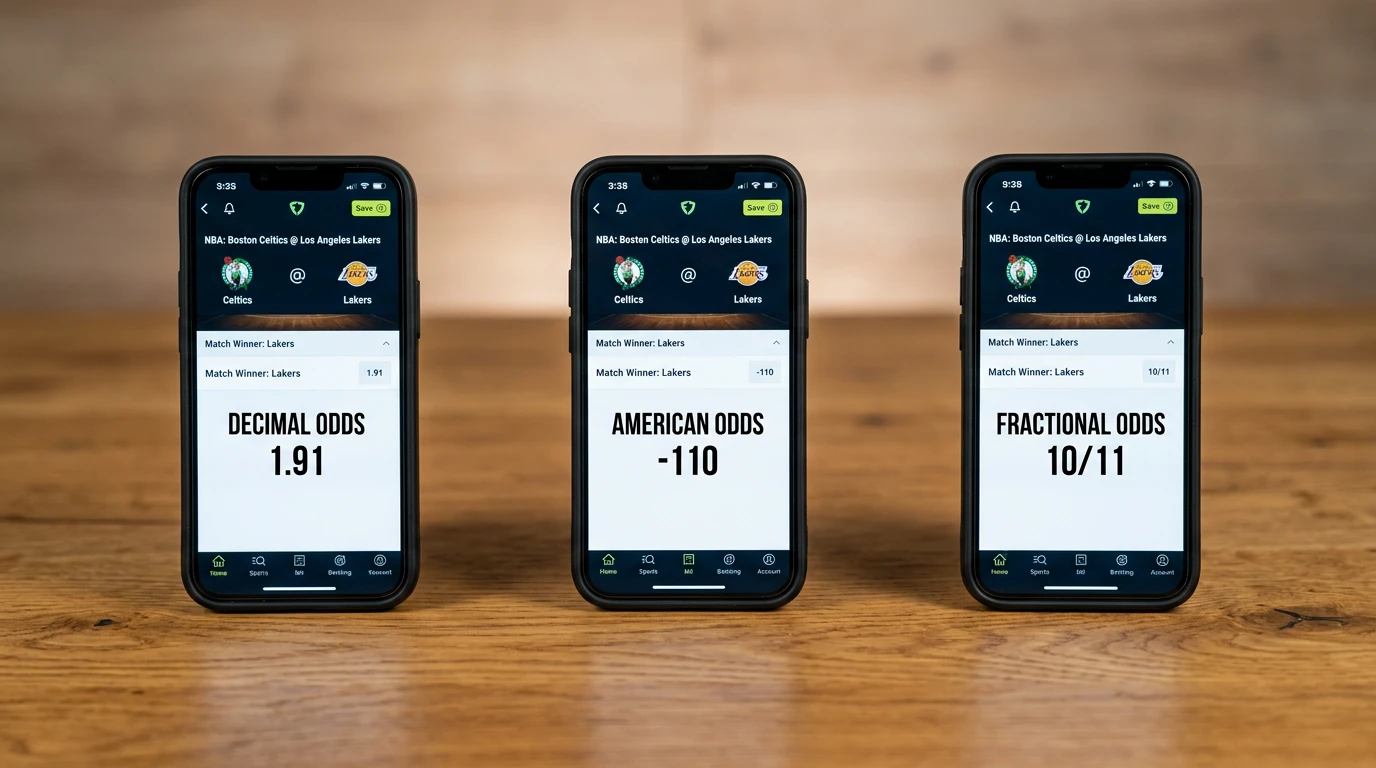
Analyzing Bookmaker Odds Display Formats
Three numbers walk into a bar. They all describe the same outcome on the same NBA game, and yet none of them look anything like each other. 1.91. −110. 10/11. They are mathematically identical. They mean a 52.4% implied probability and a 4.55% bookmaker’s margin. But to a punter who’s never seen all three side by side, they look like three completely different prices.
The difference matters because UK books, US books and old-school British high-street shops still each have their preferred display. UK online sportsbooks default to decimal. American sportsbooks default to American odds. The Coral on the high street might still show fractional. With a UK gambling market growing at a projected 11.4% compound annual rate through 2030, more punters than ever are bouncing between displays – and getting confused.
The good news is the conversion is mechanical. Once you build the muscle memory, you’ll glance at any odds format and instantly know what the price means. The bad news is until you’ve done it a hundred times, your gut keeps reading them as different prices when they’re not.
Decimal: Total Return per £1 Stake
Decimal is the cleanest format for a UK punter because the calculation involves no mental gymnastics. The decimal number is your total return per £1 staked, including the stake itself.
So decimal of 1.91 means £1.91 back per £1 in. A £10 bet returns £19.10 – your £10 stake plus £9.10 profit. Decimal of 2.00 means even money: £10 in, £20 out, £10 profit. Decimal of 5.00 means £10 in, £50 out, £40 profit. The shortcut your brain learns is: stake times decimal equals total return. Subtract the stake to get profit.
Implied probability falls out of the decimal in one division. Probability = 1/decimal. So 1/1.91 = 52.36%. 1/2.00 = 50%. 1/5.00 = 20%. With UK online operators reporting £1.45 billion in gross gambling yield in the first quarter of 2025, decimal is the format the vast majority of UK NBA bettors actually see day-to-day.
One quirk worth knowing: decimal odds shorter than 2.00 are favourites. Decimal odds longer than 2.00 are underdogs. Decimal odds of exactly 2.00 are coinflips, sometimes called “evens” in older British betting language. The threshold of 2.00 is the dividing line, and it’s worth keeping in your head as a sanity check.
American: Plus and Minus Hundred
American odds use £100 as the reference unit. A minus number tells you how much you must risk to win £100 of profit. A plus number tells you how much profit you win on a £100 stake. Everything is anchored to that hundred-pound benchmark.
So −150 means risk £150 to win £100 in profit. The total return on a winning bet is £250 – your £150 stake plus £100 profit. +200 means risk £100 to win £200 in profit. Total return on a winning bet is £300.
The reason American odds use plus and minus rather than a single decimal is historic – US sportsbooks evolved from a culture where every bet was sized in £100 chunks. The display has stuck because it makes a clear visual distinction between favourites (always negative) and underdogs (always positive). When you see −180 on an NBA moneyline, you know without reading further that the team is favoured.
The conversion to decimal is mechanical. For minus numbers: decimal = (100/absolute value) + 1. So −180 becomes (100/180) + 1 = 0.556 + 1 = 1.556, rounded to 1.56. For plus numbers: decimal = (positive value/100) + 1. So +200 becomes (200/100) + 1 = 3.00. The reverse conversions: decimal under 2.00 maps to American minus, decimal over 2.00 maps to American plus, decimal of exactly 2.00 maps to American +100/−100.
Fractional: Profit Over Stake
Fractional odds are the British high-street tradition. The display looks like 5/2, 9/4, evens, 11/10, 4/7. The format expresses profit-over-stake. So 5/2 means £5 profit for every £2 staked, or a £25 win on a £10 bet plus the £10 stake back.
Reading fractional fluently takes practice. 11/10 means £11 profit on £10 staked, which is the fractional version of −110 American or 1.91 decimal. 10/11 means £10 profit on £11 staked, which is the fractional version of +91 American or 1.91 decimal – wait, those are the same. They are the same. The confusion comes from the order of the fraction telling you whether the price is a favourite or an underdog. 11/10 is a slight underdog. 10/11 is a slight favourite. The numerator larger than the denominator means underdog; the denominator larger than the numerator means favourite.
“Evens” or 1/1 is the coinflip – same as decimal of 2.00 or American +100/−100. UK punters who grew up on football betting will recognise these instantly. UK punters who came over from US-influenced betting often won’t, and the high-street displays catch them out.
To convert fractional to decimal: divide the numerator by the denominator and add 1. So 5/2 = 2.5 + 1 = 3.50. So 4/7 = 0.571 + 1 = 1.57. Most modern UK online sportsbooks let you toggle the display in your account settings, which is the practical solution: pick decimal, save the conversion table for the few times you encounter fractional in the wild.
Conversion Formulas Side by Side
The full conversion lattice for NBA punters is worth memorising once and saving on your phone forever after. Here are the bridges between all three formats.
From decimal to American: if decimal is 2.00 or higher, American = (decimal − 1) × 100, displayed as plus. So decimal 2.50 becomes +150. If decimal is below 2.00, American = −100/(decimal − 1). So decimal 1.50 becomes −100/0.50 = −200.
From decimal to fractional: subtract 1, then express as a fraction in lowest terms. So decimal 3.50 becomes 2.50/1, simplified to 5/2. Decimal 1.91 becomes 0.91/1, expressed as 91/100, which simplifies awkwardly – most UK books round to 10/11 for display.
From American to fractional: positive American divided by 100 gives the fractional numerator over 1. So +250 becomes 250/100 = 5/2. Negative American means flipping the ratio: −150 becomes 100/150 = 2/3. The shortcut for the most common NBA price: −110 American = 1.91 decimal = 10/11 fractional. Memorise that triplet and the others fall into place. To convert any of these formats into the underlying win probability and use the result for value-spotting, the breakdown in how to turn NBA odds into a win chance walks through the full devigging process.
Which odds format does the average UK NBA bettor use?
Decimal. Almost every UKGC-licensed online sportsbook defaults to decimal display, and the format is by far the most common at UK-facing books for NBA markets. Younger UK punters who grew up with online betting almost never see fractional in practice. The exception is older high-street betting shops, where fractional is still the visible default on coupons and live boards. If you’re betting NBA online in the UK, decimal is what you’ll see, and decimal is what your bet slip will calculate in.
Are fractional odds still common at high-street UK shops?
Yes, fractional is still the default display in most UK high-street betting shops, including the larger chains that double as online operators. The high-street tradition runs deeper than online – coupons are printed in fractional, screens above the counter show fractional, and casual punters who walk in are often more comfortable with that format. Online, the same brands almost universally default to decimal because their core online users prefer it. Most UK books let you switch the display in account settings if you want fractional online or decimal in shop.
Created by the ”how Does nba Betting Work” editorial team.