GamStop and Self-Exclusion for NBA Bettors in the UK
 Available in US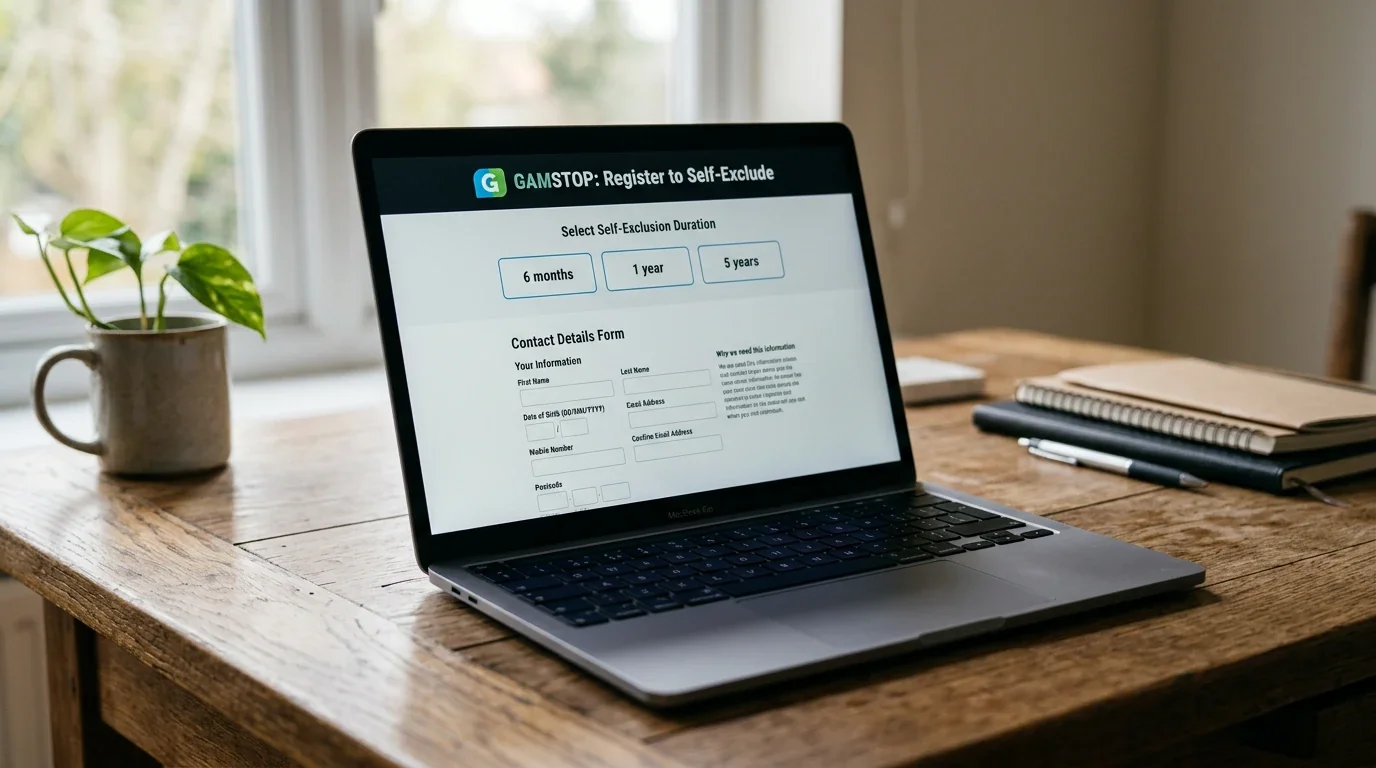
What GamStop Does and What It Doesn’t
A reader of this site emailed me last winter asking whether registering with GamStop would stop him from watching NBA games. He’d talked himself into a knot – convinced that the self-exclusion register somehow connected to the league pass account or the broadcast streaming. It doesn’t, of course. GamStop blocks access to UK-licensed gambling sites and apps. It has nothing to do with watching basketball, reading box scores, or following the league. The conflation he’d made is more common than you’d expect, and it tells you something about how anxiety distorts the picture when someone is contemplating the tool.
Self-exclusion is the most powerful single intervention available to a UK NBA bettor who’s decided that the relationship with betting has slipped. GamStop is the national multi-operator self-exclusion service – register once, and the system blocks your access across every UK-licensed gambling operator simultaneously. There are 1.5 million UK accounts now actively using safer-gambling tools, with self-exclusion being the heaviest of those tools.
What GamStop doesn’t do is just as important to understand as what it does. It doesn’t connect to your bank, doesn’t block payment cards, doesn’t stop you from accessing offshore sites that aren’t UK-licensed, and doesn’t take any action on your credit file. It’s a list of accounts that UK operators are required to check before allowing access, and it’s tied to your name, address, date of birth and email – the operator-side identifiers that get you barred at the registration and login stages.
This walk-through is for two audiences. The NBA bettor who’s wondering if GamStop is the right step for them, and wants to understand the mechanics before committing. And the punter who already knows someone in their life who needs the tool, and wants to be useful in pointing them at it. Both audiences benefit from clarity. The architecture is well-designed, and the misconceptions in the wider conversation cost real outcomes.
How GamStop Covers UK NBA Books
The mechanic is straightforward. You visit the GamStop website, complete a registration form with your full name, address, date of birth and email, and choose a self-exclusion period. The system writes your record into the central database. UK-licensed operators query that database when customers attempt to register, log in, or perform certain account actions. If your record matches a query, the operator must deny access. The block is enforced operator-side, not browser-side, so changing devices doesn’t break it.
Coverage is comprehensive across UK-licensed gambling. Every UK NBA book – every operator that accepts UK customers under a Commission licence – participates in GamStop. That’s structurally required by the licence terms. An operator that doesn’t check the GamStop register or that ignores a match faces enforcement action. The Commission completed 9,700 compliance actions in the most recent reporting window, and GamStop adherence is one of the supervised areas.
What that means in practice: if you self-exclude on a Tuesday and try to open a new NBA betting account at any UK book on Wednesday, you’ll be blocked at the registration step. The operator’s KYC flow includes a GamStop check, and a positive match terminates the registration. If you have an existing account at a UK book and you self-exclude, that account is closed by the operator within a defined window – typically 24 to 48 hours – and you can’t log back in for the duration of your self-exclusion period.
The 5,825 licensed UK retail offices – the brick-and-mortar betting shops – also enforce GamStop, but the mechanic is different. Retail operators are required to refuse service to known self-excluded customers, but the verification depends on staff recognition or ID checks at the point of bet placement. The architecture is less airtight than the online layer, and that gap is one of the recognised limitations of the framework. Most retail betting in the UK doesn’t involve NBA markets specifically – basketball is overwhelmingly an online product in the UK book mix – but the gap exists.
What GamStop doesn’t cover is the offshore site. An operator licensed in Curaçao or Anjouan that accepts UK customers despite not holding a UK Commission licence has no obligation to check the GamStop register. These operators are illegal to use under UK law and offer none of the regulatory protections of the licensed market. Self-excluded customers who circumvent GamStop by going offshore lose every protection the UK framework provides – affordability checks, dispute resolution, deposit limits, and the underlying structural integrity of the books themselves.
Single-Operator Self-Exclusion
GamStop is the heaviest tool. The single-operator self-exclusion is the lighter alternative – a self-imposed block at one specific UK NBA book without registering across the entire market. Every UK-licensed operator is required to offer this, and the mechanic is similar to GamStop but bounded to that operator alone.
Why use single-operator instead of GamStop? The most common scenario is a punter who’s developed a problematic pattern with one specific book – usually because they had a heavy promotional welcome offer, ran up volume there, and want to break the relationship with that brand specifically. They don’t have a problem with NBA betting in general; they have a problem with how that specific operator’s interface, notifications and promotional cadence has hooked them. Single-operator self-exclusion solves the targeted problem without the broader commitment.
The trade-off is obvious. If your underlying issue is with NBA betting itself rather than with one specific operator, single-operator exclusion just routes you to a different UK book where the same pattern repeats. Self-aware bettors generally know which version of their situation they’re in. The honest internal answer – “is this about Operator X specifically or about the activity itself” – drives the right choice between the tools.
Single-operator periods vary. Most UK books offer six-month, one-year and five-year options matching the GamStop tiers, but some offer shorter cool-off periods of a few weeks or a single month. The shortest option in many books is 24 hours, which functionally is more of a “time-out” than a self-exclusion. The boundary between cool-off and self-exclusion isn’t perfectly defined, and the labelling varies.
Time-Out and Cool-Off Tools
Below self-exclusion sits the time-out tool – a temporary self-imposed pause on account activity, typically ranging from 24 hours to six weeks. UK operators are required to offer time-out functionality, and it’s the lightest-weight tool in the safer-gambling stack.
Time-outs work for the kind of moment that doesn’t justify a hard exclusion but does justify a forced pause. A bad weekend slate. A late-night decision-fatigue spiral after watching too many bad fourth quarters. A run of three losing weeks that’s starting to feel like tilt rather than variance. The time-out is the one-click intervention that stops the immediate impulse without making a longer-term commitment.
The mechanic at most UK books: you click time-out from the account menu, choose a duration from a preset list, confirm, and the account goes inactive for that period. Logins are blocked. Bet placement is blocked. Deposits are blocked. Withdrawals are sometimes still possible – operator policies vary – but the betting flow is closed. At the end of the time-out, the account auto-reactivates without further confirmation.
This is also where the deposit limit framework intersects with self-exclusion most directly. How UK deposit limits work for NBA bettors covers the mechanics in detail, but the integration matters here: a punter using time-outs frequently is probably someone who should also be checking their deposit limit calibration. Time-outs are an acute intervention. Deposit limits are a structural one. They work better in combination than separately.
The 0.2% UK problem-gambling prevalence figure includes the cohort that uses time-outs and self-exclusion most heavily. The prevalence number isn’t the population that’s already in trouble – it’s the population that meets formal diagnostic thresholds at a single survey moment. The wider population using safer-gambling tools is much larger, and the architecture works precisely because it serves the broader cohort, not just the formally-diagnosed end.
UK Support Pathways
Self-exclusion alone doesn’t solve underlying patterns. The block is mechanical – it stops the activity but doesn’t address the reasons the activity reached problematic levels. The UK has a layered support infrastructure that complements the technical tools, and using both together produces better outcomes than using either in isolation.
The National Gambling Helpline runs as a 24/7 phone and webchat service for UK callers. It’s free, confidential, and staffed by trained advisors who can assess the caller’s situation and route them to appropriate next steps. For NBA punters who’ve recognised they need support, the helpline is the lowest-friction entry point. The advisors don’t moralise, don’t pressure, and don’t push specific outcomes – they listen and they map the support landscape.
NHS gambling clinics, funded substantially through the post-2025 statutory levy, provide structured clinical treatment for cases that meet referral thresholds. Treatment typically combines psychological intervention – cognitive behavioural therapy is the most common modality – with practical support around debt, relationships, and the operational mechanics of disengaging from gambling. The clinics accept self-referrals, GP referrals, and referrals through the helpline. Waiting lists exist but have shortened with the levy-funded capacity expansion.
GamCare and the Citizens Advice gambling support service offer non-clinical support – peer groups, structured phone counselling, financial guidance, and information services. These complement clinical treatment for cases that don’t meet clinical thresholds or that benefit from layered support. The peer-group format works particularly well for sports bettors specifically, where the cohort dynamics around match-day rituals and routine make group conversation more useful than abstract talk-therapy frameworks.
For close family or friends of someone showing problematic patterns, the GamCare friends and family support service is a structured pathway. Watching someone you care about develop a gambling problem is a specific kind of strain, and the affected family architecture has its own support infrastructure. The 22.5 million UK adults betting at least monthly include a significant proportion of recreational punters, but the affected-others population around problematic cases is multiples larger than the formal-diagnosis population, and the support infrastructure recognises that.
None of this is exclusive to NBA betting. The frameworks apply to all UK gambling activity. But for an NBA-specific punter, the practical reality is that self-exclusion plus support beats self-exclusion alone, and the support infrastructure is more accessible and better-funded in 2026 than it was even two years ago.
The Tool Is Heavier Than It Sounds and Lighter Than You Fear
Most UK NBA bettors will never need GamStop. The recreational majority sets a deposit limit, bets a season responsibly, ends the year roughly where they expected and never approaches the threshold where self-exclusion becomes relevant. The architecture isn’t built for that majority – it’s built for the minority where things slip, and where a hard reset becomes the right tool at the right moment.
Recognising the moment is the harder skill than using the tool. By the time someone is ready to admit they need GamStop, the slippage has usually been visible for weeks or months. The structural protection is most effective when applied before the deepest slip rather than at the bottom – but applied at the bottom, it still works. The 1.5 million UK safer-gambling tool registrations represent a population that took the step, and the empirical outcome data on those who self-exclude shows meaningful improvement against the counterfactual of continuing unimpeded.
The friction of self-exclusion is real. You lose access for the period you committed to. The UK NBA market, with all its convenience and depth, is closed to you while the exclusion runs. That’s the point. The architecture trades short-term frustration for long-term welfare, and the welfare science supports the trade. For the bettor considering it tonight, the honest assessment of where they sit on the recreational-to-problematic spectrum drives the decision better than any external advice.
Can I sign up to a UK NBA book if I’m GamStop-registered?
No. UK-licensed operators are required to check the GamStop database at registration and at certain account actions, and a positive match means access is denied for the duration of the self-exclusion period. Attempts to register a new account during the exclusion will be blocked. Once the exclusion period ends, you must complete a separate reactivation step before access is restored.
How long is the shortest GamStop period?
The shortest GamStop self-exclusion period is six months. Below that, the appropriate tool is single-operator self-exclusion or a time-out, which most UK books offer in shorter durations from 24 hours up to six weeks. The six-month minimum on GamStop reflects the architecture’s intent – it’s a heavier intervention designed for sustained periods of disengagement rather than brief cool-offs.
Published by the how Does nba Betting Work team.