Live NBA Player Props: Next-Basket and Possession-Level Markets
 Available in US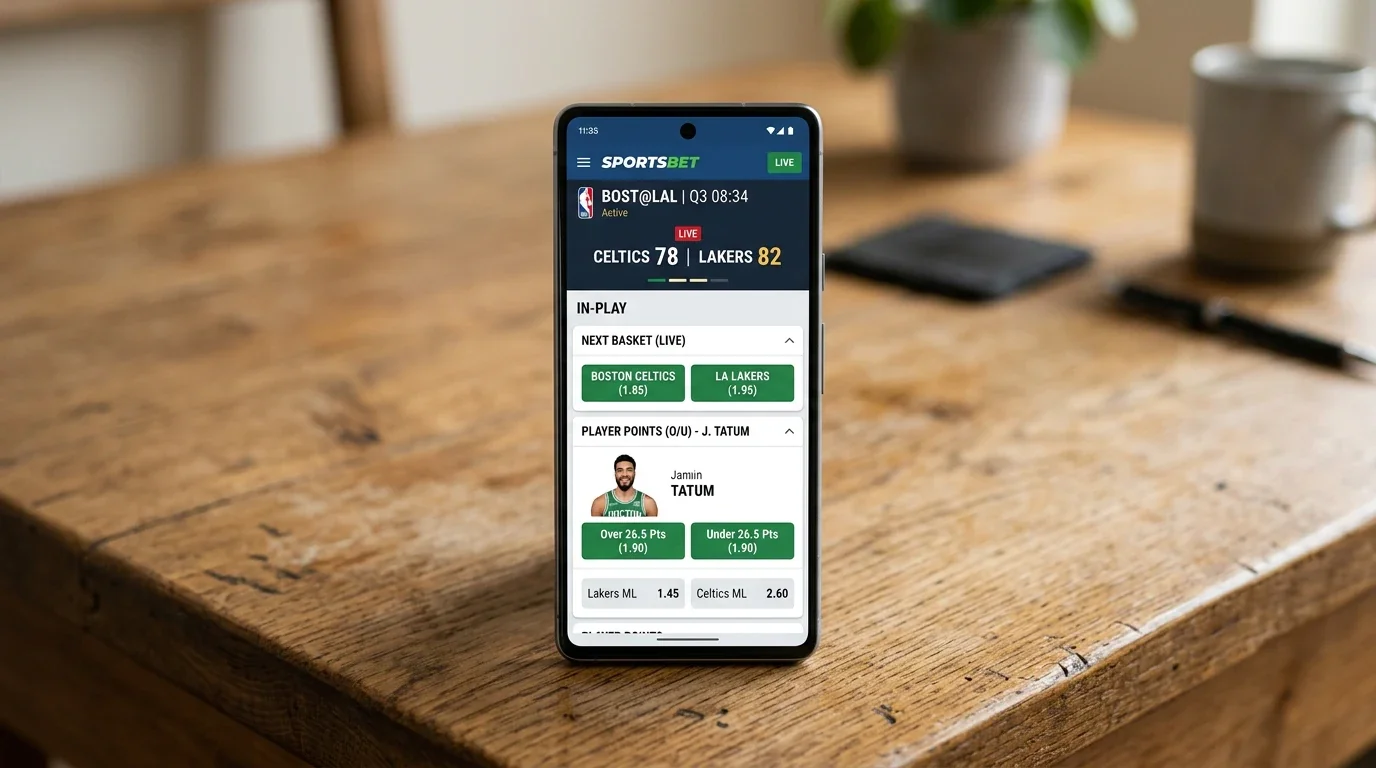
Markets That Open and Close in Seconds
The first time I bet a “next basket scorer” market on a UK NBA app, I spent six seconds choosing the player, two seconds confirming the stake, and the bet was suspended before I could tap submit. The opposing team had grabbed the rebound and pushed in transition while my brain was still processing the previous possession. The market opened, lived, and closed inside the time it takes to type a short text message. That’s the rhythm of live NBA props in 2026, and it’s a different game from anything pre-tip-off betting prepares you for.
UK live prop markets have evolved from a curiosity to a core revenue line in just a few years. Rene Simanovic, head of trading strategy at Entain, has flagged in industry forums how basketball has climbed in operator portfolios – the “explosive growth in basketball volume in our books across European jurisdictions” is how he framed it recently. The rise is partly viewership-driven (the NBA App saw a 52% jump in UK users this season) and partly product-driven, with operators investing heavily in the live-pricing infrastructure that makes possession-level markets viable.
The 130-plus international players in the NBA on opening-night rosters drives some of the European interest, but the deeper reason live props work commercially is technological. Sub-second pricing engines, low-latency data feeds, and mobile-first interfaces converged into a product where a market can open, get bet on, and settle inside fifteen seconds. The customer experience is unlike any other gambling product on the market.
I’ll work through the actual mechanics: how next-basket markets price and settle, how live stat-line updates differ from pre-game props, where latency risk eats into your edge, and the discipline framework that separates customers who survive in this volatile environment from those who get systematically wrecked by it.
Next Basket and Method
Next basket is the simplest live prop on the menu and the most volatile. The market asks: which team scores next, or sometimes which player scores next, sometimes with a method-of-scoring layer (three-pointer, two-pointer, free throws). The market opens at the start of a possession and closes the moment the next score happens or a turnover/end-of-quarter event resets it.
The pricing on next-basket lives entirely in possession context. A team coming out of timeout with a designed play has different next-basket pricing than the same team in transition. A team trailing by twenty has different pricing than one tied late. The model bakes possession state, foul-bonus situation, lineup data, and shot-clock context into a price that updates between possessions.
The customer-side reality is that you’re betting against a model that has more inputs than you can possibly process in the few seconds the market is open. Your edge isn’t going to come from out-thinking the model on a single possession. It’s going to come from spotting moments where the model lags reality – a substitution the data feed hasn’t yet caught, a defensive change the model can’t see, a fatigue signal that requires watching that the operator’s quant team doesn’t capture.
Method-of-scoring layers add complexity. “Next basket scored as a three-pointer” pays much longer odds than “next basket by Player X” but settles less often. The market is wider, the variance is higher, and the operator margin is generally wider too. Method markets are where I see the most visible margin extraction – the implied probability across all method outcomes typically adds up to noticeably more than 100%, with the operator banking the spread.
Settlement on next-basket is fast. Most UK books settle within seconds of the resolving event, with payment crediting to your account immediately. There’s no overnight grading process for these markets – they live and die in the possession window, and the cash hits your balance before the next play starts.
Live Stat-Line Updates
Live versions of pre-game stat-line props – points, rebounds, assists, threes-made – operate differently from next-basket. The market line moves continuously through the game as the player accumulates the relevant stat, and the operator re-prices the over/under given the time remaining and the player’s current production rate.
The pricing logic is straightforward. A player on a 22-point pre-game line who has 14 points at half-time has a live line that’s higher than 22 – usually around 26 or 27, depending on minutes played and pace expectations. The over on the original 22 is now heavily favoured at the live odds, and the new live line of 26 represents the operator’s view of where the over/under should be from this moment.
The opportunity in live stat-line props is twofold. First, mispriced live lines where the operator hasn’t fully accounted for game state factors – pace differential, foul trouble of opposing players, lineup changes affecting matchups. Second, the over/under decision on a player who’s tracking either above or below his season average, where the live line may not fully account for the underlying matchup factors that drove the divergence.
The trap in live stat-line is recency bias. A player who’s missed three shots in a row pulls the under bettor’s attention; a player who’s hit four threes in five minutes pulls the over bettor’s attention. The model knows roughly how to weight recent action against base rates, and the model is generally less recency-biased than the human watching. Mistaking your own recency bias for an edge is the most common error I see in this segment.
Reading how UK NBA cash out works is closely related – the same probability calculations that drive cash-out values on pre-game props are essentially the live stat-line market for the same outcome, just expressed differently. A pre-game points prop that’s tracking well will show a high cash-out value and a high live line for the same player, and the relationship between them is mathematically tight.
Latency Risk and Stream Delay
Latency is the structural risk in live betting that customers underestimate constantly. The events you see on screen – through the broadcast, through the live data display in the operator’s app, through any separate score-tracking source – arrive on different timescales, and those differences are exploitable by anyone with faster information than the operator’s pricing engine.
The standard latency stack: the venue cameras capture the action in real time. Broadcast feeds add 8-12 seconds of delay through production and transmission. UK satellite or streaming feeds add another 5-15 seconds depending on the path. Operator data feeds typically run a few seconds behind the venue, faster than broadcast but not real-time. Your phone’s display reflects the operator’s data feed, which is usually a second or two behind the operator’s internal pricing model.
The implication: if you’re watching a UK broadcast of an NBA game while betting live on the operator’s app, you’re acting on information that’s 10-20 seconds behind the actual game state, while the operator’s pricing engine is acting on information that’s 1-5 seconds behind. The operator has a structural information advantage on every live bet you place, and the markets are priced accordingly.
What this looks like in practice: you see a steal on the broadcast. You think you’ve got an edge betting against the team that just turned the ball over. By the time you tap into the market, the steal has already been converted into a transition basket the operator’s model fully prices, and the line you bet at already reflects the outcome you thought you were ahead of. You bought information the market had already absorbed.
The defensive position is to assume your information lag is real and bet on slower-moving signals rather than fast ones. Lineup changes the operator may not have priced. Macro game-flow shifts that play out over multiple possessions. Player-specific patterns that need observation longer than the latency window can hide. Trying to win on instant reactions to single events is the customer pattern that loses most consistently.
For UK punters watching games on the league pass app, the latency is similar to broadcast but with different lag characteristics. The 52% growth in UK NBA App users this season includes many bettors using the streaming app for game-watching, and being aware of the lag relative to operator pricing is part of the basic competence required for sustained live betting.
Discipline for Live Prop Betting
The live prop ecosystem rewards discipline more brutally than any other corner of NBA betting. The volatility is high, the volume of available markets is enormous, and the friction of placing each individual bet is essentially zero. Without a process, the customer drifts into volume that has no underlying edge – betting because the market is open rather than because the bet has positive expectation.
My discipline framework has three layers. First, a pre-game decision about which markets I’m willing to engage with on a given night. If a game has nothing pre-game-interesting about it, I don’t open the live prop screen. The willingness to skip games entirely is the foundation. Second, a positive-edge filter at the market level – I have to identify a specific reason the market is mispriced before I tap, not just a vague feeling about the player or the situation. Third, a stake-sizing discipline that scales bet size with confidence – small stakes on speculative reads, larger stakes on clear edges.
The 1.5 million UK accounts using safer-gambling tools include many live bettors, and the architecture of those tools matters specifically in the live context. Deposit limits prevent escalation. Time-out tools intercept tilt. Auto cash-out triggers can lock in gains before the live volatility wipes them. The cash-out architecture for UK NBA bets integrates closely with live prop discipline because cash-out and live props are essentially two sides of the same in-play market structure.
Ending a session before the urge to keep tapping fades is harder than starting it. The architecture of live betting – instant settlement, fast re-bet, low friction – is engineered to maximise volume, and customer-side discipline has to push back against that. Setting a session-end time before you start, sticking to it regardless of how the session is going, and walking away when the timer hits is the structural defence.
The customers I know who profit consistently in live NBA props all share a few traits. They bet small portions of their bankroll on individual live bets. They skip far more markets than they engage with. They keep records, review them, and adjust based on outcomes over hundreds of bets rather than dozens. They treat each session as a single business day rather than a single shot at the market. The volume of live props makes that discipline harder, and the absence of it makes the volume into a leak rather than an opportunity.
Living With the Speed
Live props are the highest-volatility, lowest-friction segment of the UK NBA betting market. They reward the customer who can integrate fast-pricing markets with disciplined process, and they punish the customer who treats them as a constant opportunity for impulse action. The middle ground is rare – most punters land on one side or the other within a few sessions.
For UK NBA bettors interested in developing live prop competence, the path is incremental. Start by watching markets without betting them. Track how the lines move, where the operator’s pricing seems sharp, where it seems lagging. Place small stakes selectively, only where you’ve identified a specific reason the market is off. Build the bankroll for live props separately from your pre-game bankroll, and review live results separately so you can see whether the segment is profitable for you.
The infrastructure behind live NBA props will continue to develop. Operator pricing engines will get faster and tighter. Customer interfaces will get richer. The product will continue to grow as a share of the UK NBA market, and the customer-side skill required to navigate it will continue to be the differentiator between profitable and unprofitable participation.
How quickly does a UK book settle a ‘next basket’ bet?
Most UK operators settle next-basket markets within seconds of the resolving event, with payment crediting immediately. The market opens at the start of a possession, suspends or closes when the next scoring event happens, and the bet grades against the outcome before the following possession starts. There’s no overnight processing – these markets settle in real time.
Is live prop pricing different from pre-game?
Yes, structurally. Live prop pricing reflects the time-decayed remaining probability of the prop hitting, plus the operator’s margin, plus a faster reaction window than pre-game pricing has. Live props can have wider operator margins than pre-game equivalents, particularly on lower-liquidity markets, because the pricing engine has more uncertainty and operators price that uncertainty into the customer-facing odds.
Published by the how Does nba Betting Work team.