Point Spread Mechanics: Evaluating Basketball Handicaps
 Available in US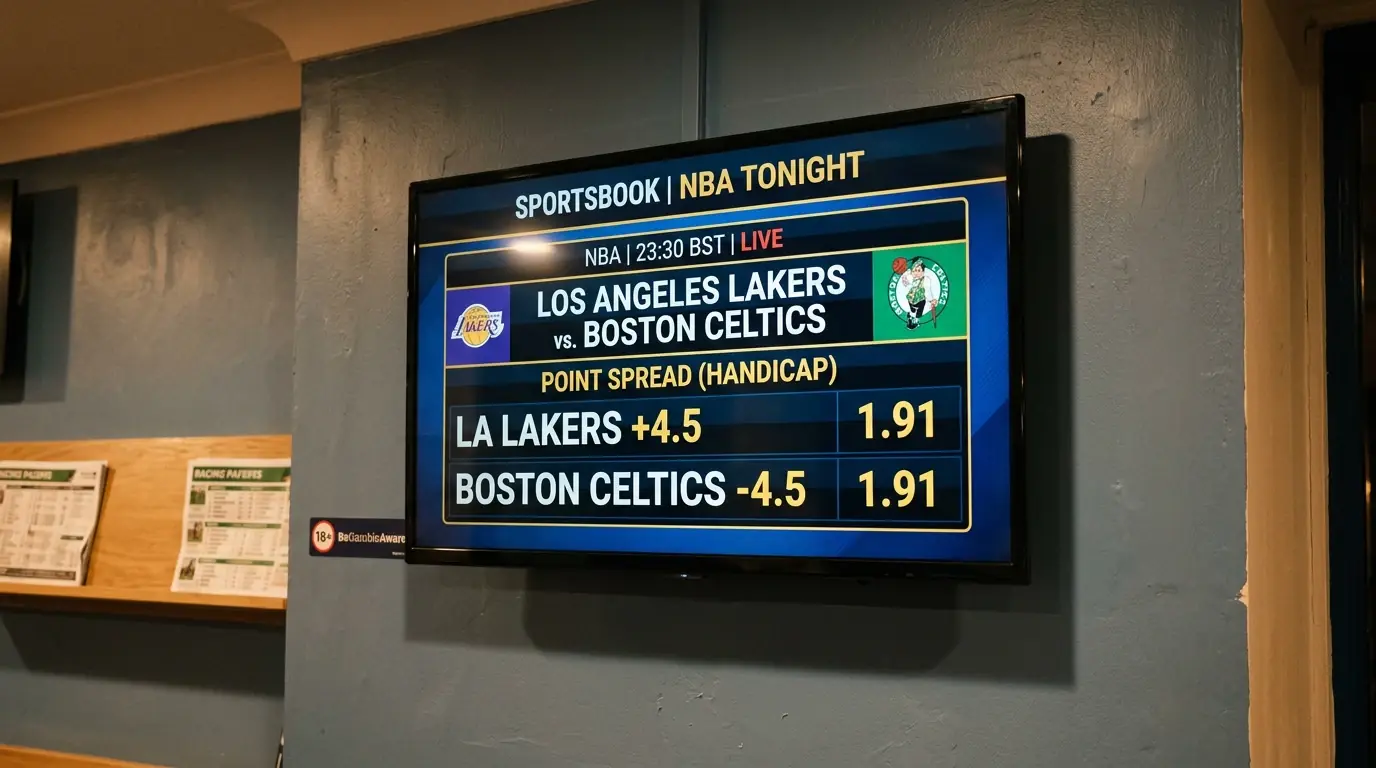
Point Spread Pricing and Matchup Handicaps
I’ll start with a confession. The first NBA spread I ever bet, I read upside down. I backed Boston −7 thinking I needed them to lose by less than seven, won the game by twelve, and spent the next forty minutes convinced I had lost £50. I had won. The bet slip was clear. My brain was not.
That’s the thing about spreads – the maths is simple, but until you see fifty of them, your gut keeps reading them backwards. So let’s get the bones right. A point spread, sometimes called a handicap on UK football coupons, is a numerical adjustment the bookmaker hangs on the favourite to even the contest in betting terms. Boston −7 means Boston must win by eight or more for the bet to land. Detroit +7 means Detroit must lose by six or fewer, or win outright, for the bet to land.
The NBA is the perfect sport for this market. Eighty-two regular-season games, scoring totals that hover between 220 and 240 points, and matchups that swing wildly in talent. Spreads from −1.5 to −18 are routine. With basketball generating around 32% of all US legal betting handle, the spread market sees enough action that the prices stay sharp on the high-profile games – but soft pockets show up on early-week midwest matinees if you know where to look.
How a Spread Number Is Set
The opening number is built from a power rating, a home-court adjustment, and a rest-and-travel layer. That’s the trader’s recipe in three words. Power rating means the book’s internal estimate of how good each team is right now, expressed in points per game on a neutral floor. Home-court adjustment in the NBA used to be a flat three points across the league. It isn’t anymore. The Denver altitude effect, the Madison Square Garden buzz, the late-night Pacific games for East Coast travellers – these get priced individually now.
Rest matters more in basketball than in any other major sport I’ve tracked. A team on the second night of a back-to-back loses roughly two to three points off the line. Add a cross-country flight on top and you’re looking at four. Books bake this in before the spread ever opens. The market then moves it during the day as injury news lands.
Liquidity is the other ingredient nobody talks about. With the 2025-26 NBA season pulling in 170 million viewers across US broadcasts and 1.3 billion hours of global live consumption – both records – the betting volume per game is enormous. That volume forces tight pricing on marquee fixtures. The Lakers visiting Boston on a Friday night will have the spread rounded to the nearest half-point, with maybe a one-point window of disagreement across UK books. A Memphis-Sacramento game on a Wednesday in February? Two-point gaps between books are common. That’s where the line shopper earns their keep.
Covering, Pushing and the Half-Point Hook
“Covering the spread” is the phrase you’ll hear most. It just means your side beat the line. If Boston are −7 and they win by ten, they covered. If they win by exactly seven, the bet is a push – your stake is returned, no profit, no loss. UK books default to settling pushes as a stake refund on single bets. In a parlay, the leg is voided and the parlay re-prices around the remaining legs.
The half-point – the “hook” – is where the bookmaker’s quiet cruelty lives. A spread of −7 includes the push possibility. A spread of −7.5 forbids it. Move the line by half a point and you’ve changed the win probability by something like two to four percent depending on the number, which sounds tiny until you’ve lived through a Friday night where your team won by exactly the spread and you’d paid a few extra pence to get the half-point.
I’ll give you a worked example. Imagine an NBA game where the spread sits at −7 and the price is −110 on each side. A second UK book offers −7.5 at −115. Which is better? On most NBA totals around 220 points, sevens are not as sticky as they are in NFL betting, but when the line lands exactly on a whole number a few times a season, the difference between push-protection and a half-point hook adds up across hundreds of bets.
Are There Key Numbers in the NBA?
Punters who came over from American football love key numbers – three, seven, ten, fourteen – because NFL margins really do cluster around them. NBA bettors who try to import that thinking get burned. NBA margins are smoother. The most common winning margins sit around two, four, five and seven points, but the distribution is far flatter than gridiron football. There’s no “magic three” in basketball.
That doesn’t mean spreads are random around whole numbers. Books still treat 5, 7, 9 and 10 as slightly stickier than the half-points either side, especially in regular-season games where teams play conservatively in the closing minute. Watch how often a team up by six fouls instead of letting the opponent go for a three – that pattern shifts the final margin distribution and traders know it.
For a UK punter starting out, the practical takeaway is small: don’t pay a heavy premium to move from −7 to −6.5 the way an NFL bettor would. Pay attention to whether a particular team plays “garbage time” honestly, hauls starters, and lets backups dictate the final margin. Some squads cover by twelve when up by eight late. Others go to sleep with five-point leads in the fourth.
Home Court and the Spread
The home crowd is part of the line. Always has been. What changed in the last five seasons is that the size of the home edge has shrunk and become arena-specific. Empty arenas during 2020 famously dropped home-court advantage to almost zero. Fans came back, but books didn’t go back to a flat three points across all thirty teams.
I track home edge on a six-game rolling basis for every team. Some sit at four points (Denver, the louder Pacific Coast buildings). Some sit at one and a half (a few of the rebuilding rosters with apathetic crowds). When I see a UK book hanging the same generic three-point home boost on a Pacers home game and a Nuggets home game, I’m reminded that pricing isn’t always perfect – even at scale.
One more wrinkle the public misses: the NBA’s neutral-site games. Paris in 2025, Berlin and London in 2026 – these games strip the home edge out entirely, and the spread should reflect that. Books that re-price the favourite by two-and-a-half points lower on a London game are doing the job correctly. Books that don’t are leaving an edge on the floor. The pace and defence inputs that drive related markets are unpacked in the breakdown of how NBA over/under totals get priced for UK punters.
What is a ‘hook’ on an NBA spread?
The hook is the half-point at the end of a spread, like the .5 in −7.5. It removes the push possibility entirely. If the favourite wins by exactly seven, a bet on −7 refunds as a push, but a bet on −7.5 is a full loss. Books often charge a slightly worse price for the half-point, and on rare nights when the line lands on a whole number, the protection earns its keep.
Why do NBA spreads move late on game day?
Three drivers move late spreads. Injury news between 60 and 90 minutes before tip-off accounts for most of it – a star ruled out can shift a line by four points or more. Sharp money landing on one side as the line firms up is the second driver. Public weight piling on a favourite in the final hour is the third. UK books update fast, but they update at slightly different speeds, which is why scanning two or three feeds in the last hour pays off.
Prepared by the how Does nba Betting Work editorial staff.