Basketball Betting Markets: UK Spreads and Moneyline Odds
 Available in US
Table of Contents
- NBA Betting Markets: Types of Spreads and Bookmaker Lines
- Moneyline: Picking the Outright Winner
- Point Spread: The NBA’s Default Equaliser
- Totals (Over/Under): Pricing Pace and Defence
- Quarter and Half Markets (and the Overtime Trap)
- Derivative Markets: Race-To, Margin, Winning Method
- Parlays, Same-Game Parlays and Bet Builders
- Futures: Championship, Conference, MVP
- Which NBA Markets Are Sharpest in the UK?
- NBA Markets: Common Questions
NBA Betting Markets: Types of Spreads and Bookmaker Lines
The first NBA card I tried to bet on, back in 2014, had eleven games on it. I counted forty-three different markets on a single Lakers fixture before I gave up scrolling. Moneyline, spread, totals, alternate spreads, team totals, race-to-twenty, first-quarter handicap, halftime line, winning margin, and a wall of player props longer than the team roster.
That experience matters because the menu has only got bigger since. A regular UK sportsbook now publishes between thirty and seventy markets per NBA fixture, and the playoff games stretch past a hundred. The point of this article is to give you a working map of that menu — not every twig, but every branch — so when you open a Wednesday slate you know exactly which corner of the screen to look at and why.
I will work outwards from the three pillars almost every UK punter starts with — moneyline, spread, and totals — and then move into the layered markets that sit on top of them: alternate lines, quarter and half splits, derivatives, parlays, and futures. Along the way I will flag where UK rules diverge from the American defaults you see quoted on US blogs, because that gap costs money. By the end you should be able to look at any NBA fixture page and instantly classify what each market is asking you to predict and how it is priced.
One ground rule. The NBA is a high-scoring, high-pace, possession-rich sport, which means its markets behave differently from football and cricket markets you may already know. The pricing logic, the way overtime is treated, the way pushes work — all of it shifts. Read this with a football brain and you will lose money. Read it as basketball-native and the rest of the guide does most of the heavy lifting.
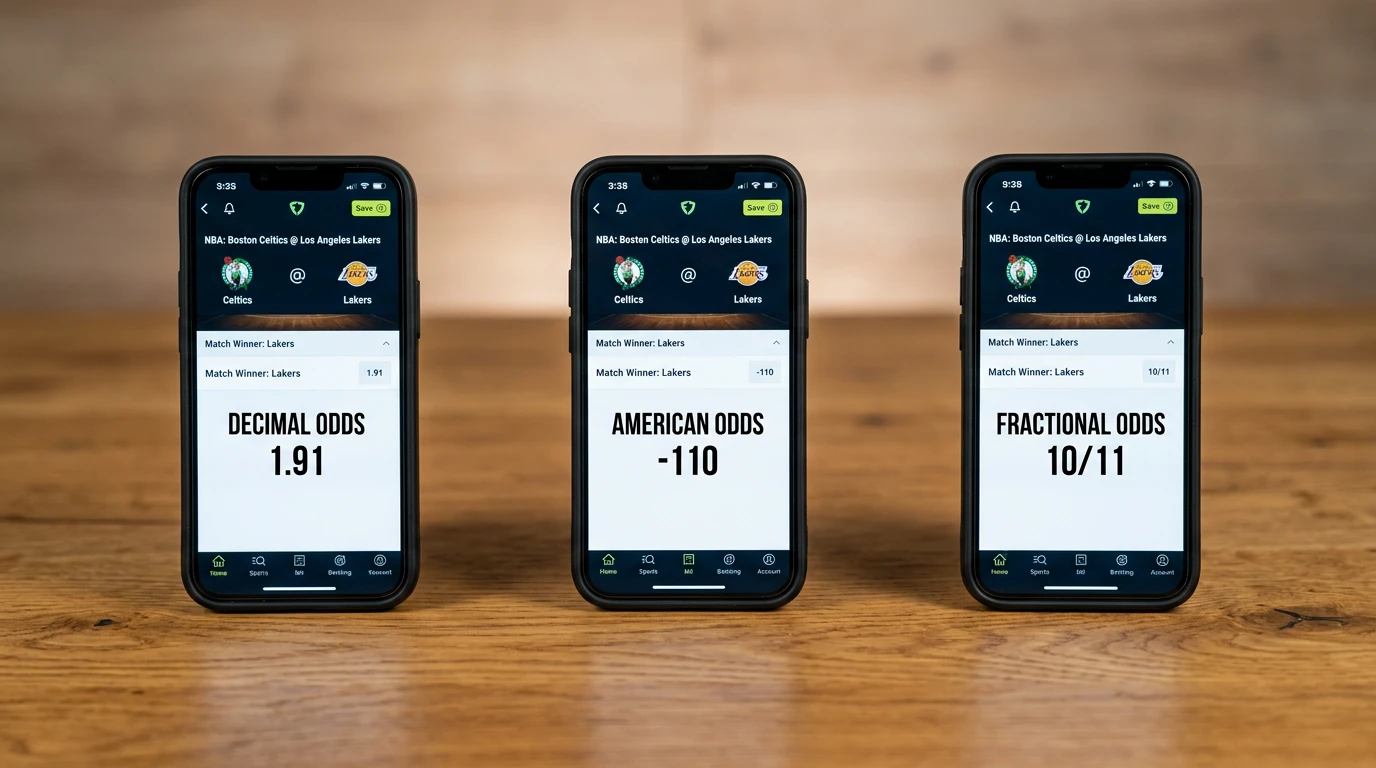
Before diving into specific wagers, it is crucial to understand how to read NBA odds in American, decimal, and fractional formats to ensure you get the best value.
Moneyline: Picking the Outright Winner
An old colleague of mine used to call moneyline “the toddler’s market” — and then he lost three months of bankroll in a fortnight backing road favourites at −280. The simplicity of the bet is exactly what makes it dangerous. You pick the team that wins. Nothing else. The only complication is the price, and the price is where the work is.
NBA moneylines run on a wider scale than football match-winner markets because the sport produces fewer upsets in regular time. A title contender hosting a tanking team will routinely price at −500 to −800, which in decimal terms is 1.20 to 1.125. To pull £100 in profit at −500, you stake £500. The asymmetry is brutal: one slip costs five wins.
That is why moneyline is the market where bankroll discipline matters most, even though it looks like the easiest bet on the page. The temptation to “lock in” a heavy favourite for a cup-of-tea win has emptied more accounts in this sport than any prop or parlay I have ever seen. Basketball is the most popular sport for betting in the United States and accounts for roughly thirty-two percent of the total US handle, which tells you something important: a lot of money flows through these lines, and the sharps know it.
The mirror image is the underdog moneyline. A scrappy road team with a healthy starting five against a rested favourite might price at +220 to +260. A £20 stake returns roughly £64 to £72 if the dog wins outright. The maths feels gentler — small stake, large win — but the long-run hit rate has to clear the implied probability, and that is harder than it looks. At +240, the implied probability is just under thirty percent, which means roughly seven in ten of those dogs lose. You need a real edge, not just a feeling that “they are due.”
One thing I will hammer throughout this article: in the United Kingdom, NBA moneyline bets settle on the final score including overtime. This is the default and it is not optional unless the market explicitly says “regulation only” or the equivalent. Football punters new to basketball get caught out by this. Overtime can flip a moneyline that looked dead with thirty seconds left in the fourth — wonderful when you are on the right side, grim when you are not.
The practical takeaway: moneyline is the right starting point for a beginner because it teaches you to read implied probability without the noise of a handicap. But it is also the market where chasing favourites destroys discipline fastest. My rule after a decade of these markets — if you cannot give me three concrete reasons the price at −320 is wrong, do not bet it. The sportsbook has more information than you do, and the price reflects that information.
Point Spread: The NBA’s Default Equaliser
Imagine the moneyline did not exist and every NBA game had to be priced as a coin flip. The spread is how the bookmaker engineers exactly that. It is the market’s way of saying: “Here is how many points we think one side wins by — bet whether they cover that gap or fall short.”
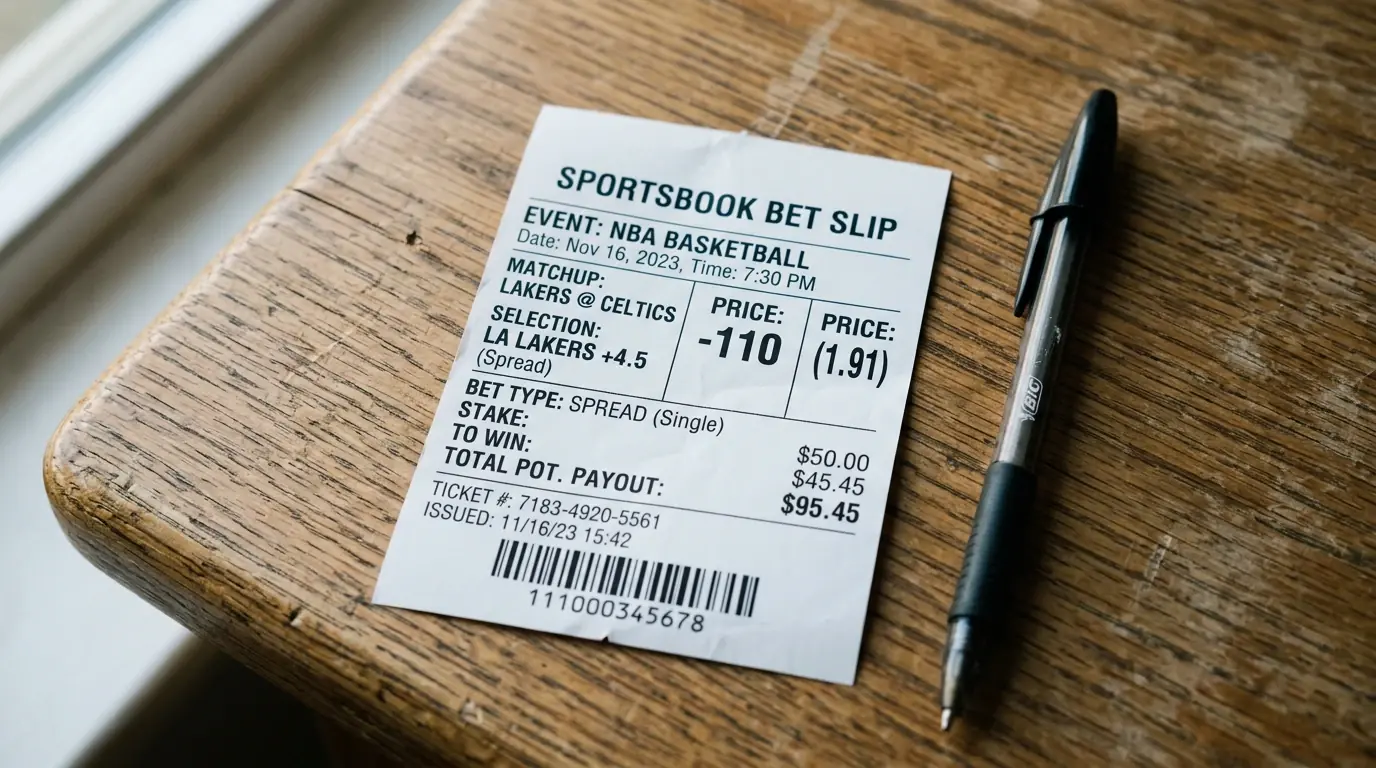
The mechanics are simple once you see one. Suppose Boston is favoured by 7.5 points over Chicago. The spread is written as Boston −7.5 and Chicago +7.5. To win a bet on Boston, the Celtics must win by eight or more. To win on Chicago, the Bulls must either win outright or lose by seven or fewer. Both sides typically price around −110 in American format, or roughly 1.91 in decimal — close to even money, with a small built-in margin for the bookmaker. That margin is the vig.
Why a half-point? Because half-points eliminate pushes. If the spread were Boston −7 and the Celtics won by exactly seven, the bet would push and stakes would be returned. Bookmakers prefer half-points because they force a clean win or loss. You will still see whole-number spreads, especially on integer-friendly margins like 3 and 7, but the half-point is the default.
The spread is the NBA’s default market because the sport is so high-scoring that the moneyline often becomes lopsided. A nine-point favourite may sit at −380 on the moneyline, whereas the same fixture on the spread offers near-even money. The spread also reframes how you watch the game. You stop caring who wins and start caring by how much.
This shift in perspective is what trips up footballers crossing into basketball. Football has a draw, so handicaps work differently. NBA spreads cannot push to a draw because the sport cannot end in a tie — overtime forces a winner. The spread is always live: every possession in the fourth, even with the game effectively decided, can swing your bet. A team up by 9 with thirty seconds left, holding the ball, can foul, give up two free throws, dribble out the clock, and “win” the game while losing the spread. I have watched this exact sequence in over a hundred games.
One British-specific note. UK sportsbooks treat spread bets as including overtime by default, mirroring the moneyline rule. If the score is tied at the end of regulation and the spread was Lakers −4.5, the bet remains live through the extra five minutes. This is not the same as classic UK “spread betting” through firms like Sporting Index or Spreadex — that is a different product entirely, with uncapped liability per point. The American-style point spread you see at every UK sportsbook is a fixed-stake market: you risk a known amount, and you cannot lose more than your stake.
The line itself is not random. Bookmakers build it from a base power rating for each team, then layer adjustments for home court (typically 2 to 3 points), rest (a back-to-back loses about 1 to 1.5 points), and missing players (a star out can shift the line 4 to 7 points, depending on usage). The closing line — the spread that exists at tip-off — is the most accurate predictor of the result you will find anywhere. Beat that closing line consistently and you have an edge.
Alternate Spreads and Buying Points
Most UK sportsbooks publish a ladder of alternate spreads alongside the main number, and this ladder is one of the most underused features on the page. If the main spread is Boston −7.5 at −110, the alternates might look like Boston −4.5 at −190, Boston −2.5 at −260, or stretched the other way, Boston −10.5 at +135.
The trade-off is obvious once you see it. Make the spread easier to cover, and the price gets shorter. Push it harder, and the price stretches. What is less obvious is when this is worth doing. Buying down to −4.5 from −7.5 is rarely a smart trade — you pay nearly double the juice for three points of cushion. The maths is brutal: at −190, you need to win about 65.5% of the time just to break even.
The reverse trade — pushing out to −10.5 for plus-money — is where I see real value, but only in specific spots. Blowout games against tanking opponents, especially when the favourite has a deep bench and a coach who runs starters into garbage time, are the candidates. At +135, your break-even rate is about 42.5%. If you cannot point to consistent margin-of-victory data backing that hit rate for the team in question, you are guessing.
The most useful trick with alternate spreads is using them to confirm or challenge your read on the main line. If you think the main number of −7.5 is too thin and the favourite should really be −10, the price on −10.5 tells you what the market thinks of that view. If −10.5 is sitting at +150, you have to ask whether your edge is really that strong. More often than not, it is not.
Totals (Over/Under): Pricing Pace and Defence
I have a friend who only bets totals. He calls them “the honest market” because they strip out narrative — no underdog story, no revenge angle, no rivalry juice — and reduce a basketball game to one question: how many points will land in those two hoops? Over the last three seasons, his approach has out-performed every spread bettor I know personally.
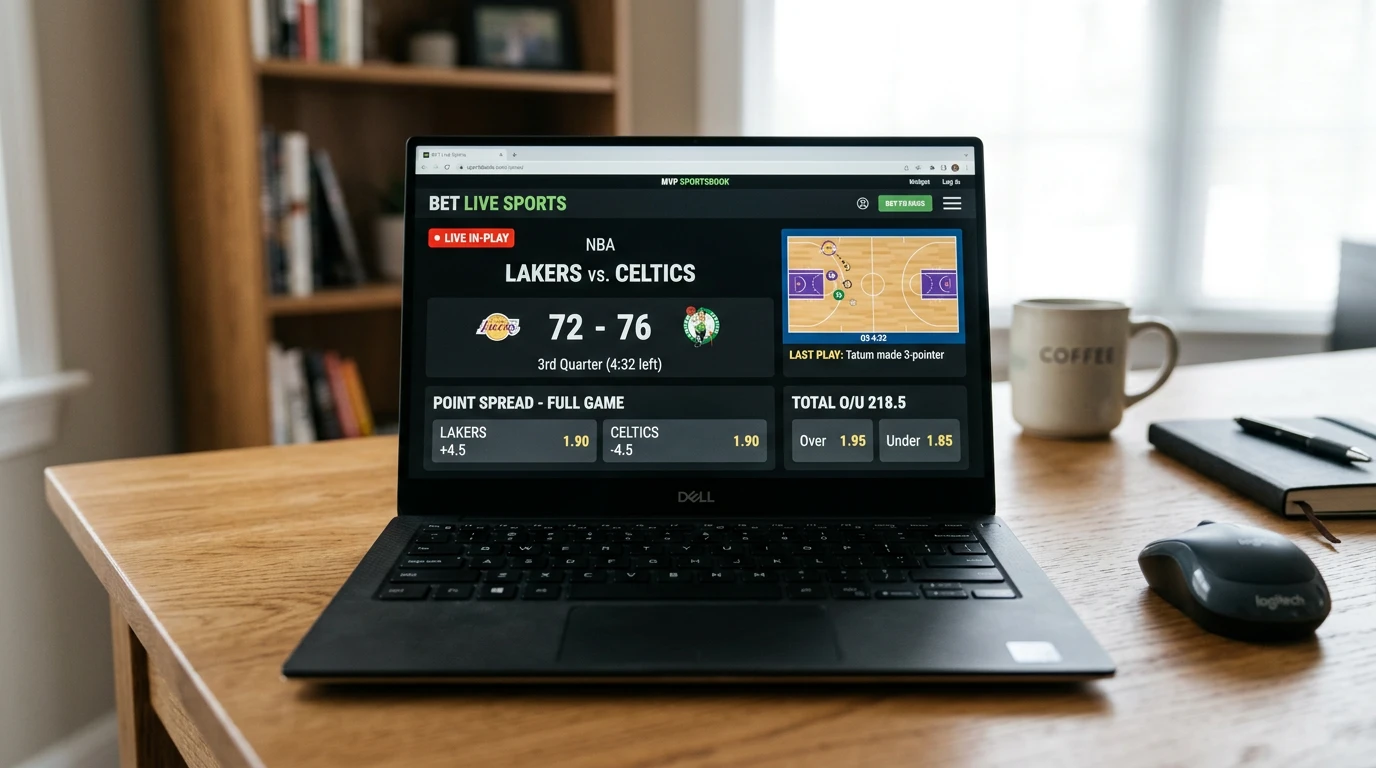
The total — also called the over/under — is a number representing the projected combined points scored by both teams. If the line is 224.5, you bet “over” if you think more than 224 will be scored, and “under” if you think 224 or fewer. Both sides are typically priced at −110, the same vig structure as the main spread.
What drives the line is not who is playing — it is how they play. The bookmaker projects pace (possessions per game) and offensive efficiency (points per possession) for both teams, then adds them together. A modern NBA total in 2026 typically sits between 215 and 240, depending on the matchup. A defensive grind might land at 217.5; a track meet between Indiana and Sacramento might settle near 245.5.
Here is a pattern worth knowing. NBA betting publics are wildly biased toward the over. Watching a game with both teams scoring is more entertaining than watching a 99–94 slog, and that emotional preference shows up in the betting handle. In the first half of the 2025–26 playoffs, more than ninety-five percent of the public handle on Game 2 of Philadelphia versus New York piled onto the over at 215.5. The line moved up; the under cashed comfortably. This is the recurring story of NBA totals: the public chases the over, the line drifts up to compensate, and disciplined money picks off the inflated number.
That does not mean the under is automatically the right side. It means you should always ask what the line is doing. If the total opened at 226.5 and the bookmaker has moved it to 229, that 2.5-point shift is a public-money signal. If the same line moved from 226.5 down to 224, that is sharp money on the under. Neither tells you which side will win, but both tell you which side already has weight on it — and weight, in this market, is information.
One more rule I drill into anyone learning this market: pace is a stronger predictor than offensive talent. Two excellent offences playing slowly will undershoot a number more reliably than two mediocre offences playing fast will exceed one. Empty possessions cap the over. The team’s preferred tempo is the first variable I look at. Star scorers are second. Defence is third. Foul rate is fourth: more fouls means more free throws and a stopped clock that adds possessions late.
Team Totals: One Side of the Scoreboard
Team totals split the over/under in half and let you bet on one side of the scoreboard. Instead of picking whether the combined score will exceed 224.5, you decide whether Boston alone will exceed 117.5, regardless of what Chicago does. Most UK books publish a team total for both sides, with prices typically −110 on each.
The market is more useful than its low profile suggests. If you have a strong read on one team’s ability to score — a hot offensive star returning from injury, a favourable defensive matchup, a bench getting heavy minutes against a tired opponent — but you are not confident about the other side, the team total isolates your edge. You bet what you actually believe, not a hybrid of both teams.
The trade-off is that team totals are usually less liquid than the main total, which means lines move slower and stale numbers can sit on the screen longer. If you spot it before the market does, you have an edge; if you are catching the late ripple, you are trading at a worse price. Note: team totals settle on the team’s full game points, including overtime, in the UK. Always check the rules tab if the wording is ambiguous — five minutes of OT can add fifteen points.
Quarter and Half Markets (and the Overtime Trap)
Here is the most expensive misconception I see among new NBA bettors: assuming a “halftime line” works the same as the full-game spread. It does not, and the difference has cost more refunds-that-never-came than I can count.
Quarter and half markets — first-quarter spread, first-half total, third-quarter moneyline — settle on the points scored within that specific period only. A first-half spread of −3.5 on Boston means Boston must lead by four or more at the halftime buzzer. What happens in the third or fourth quarter is irrelevant. Same logic for the over/under: a first-half total of 113.5 settles on the score at the end of the second period, full stop.
The overtime trap sits inside this rule. Quarter and half markets do not include overtime, anywhere, ever. If you bet the fourth-quarter total at 56.5 and the game heads into OT tied at 28-all, your bet has already settled at 56 — the under cashes. Many bettors assume the bet “carries over.” It does not. The market is sealed at the buzzer of the period in question.
This rule actually creates opportunities once you understand it. If a heavy favourite tends to start hot and coast, the first-quarter spread is often a better value than the full-game spread. The bookmakers do model these splits, but the public bets quarter markets less actively, so the line is sometimes less efficient. A practical caveat: quarter and half markets carry slightly higher vig than full-game equivalents in most UK books, often −115 instead of −110. A small edge on a quarter line can disappear inside the extra juice.
Derivative Markets: Race-To, Margin, Winning Method
Beyond the main lines and quarter splits sits a layer most punters ignore — the derivatives. Race-to markets, winning margin bands, double result, method of victory. They look like clutter on the betslip until you realise each one is a sliced view of the same game from a slightly different angle.
Race-to-twenty is the friendliest of the bunch. The market asks which team will score twenty points first. Both sides usually price between −115 and +115, depending on the matchup, and it is a fast bet — most NBA games hit the twenty mark inside the first six minutes. Race-to-fifty and race-to-100 work the same way at later thresholds.
Winning margin bands are stickier. The market lists ranges — 1 to 5 points, 6 to 10, 11 to 15, 16 to 20, 21+ — and you pick which band the final margin will land in. Prices stretch from around +250 at the most likely band to +1500 or more at the unlikely tails. The maths can be tempting, but margin bands are high-variance: a four-point shift wipes out a winning band entirely. Best treated as small-stake speculative plays.
The quiet truth about derivatives is that they exist mostly to give the betslip more colour. Most are inefficiently priced compared with the main markets, but the inefficiency runs in the bookmaker’s favour. The exception is when you have a very specific narrow read — a team you expect to start blistering hot but fade — that fits a derivative shape better than a standard line. For a deeper look at the player-side variants of these markets, the guide to NBA player props covers prop derivatives in detail.
Parlays, Same-Game Parlays and Bet Builders
Parlays — the British term is accumulators, and most UK books still use that word — combine multiple bets into one. All legs must win for the parlay to pay. The appeal is mathematical: each leg multiplies the odds, so a four-leg accumulator at −110 per leg pays roughly 12.28 in decimal odds. A £10 stake returns about £123. The catch is also mathematical: each leg compounds the loss probability.
I have a soft spot for parlays because they are how I lost my first hundred quid on basketball. The reality is that the bookmaker’s vig compounds across legs, so the more legs you add, the worse your expected value gets — even if every individual pick is a coin flip. A four-leg parlay at −110 per leg has a true fair value of roughly 15.0, but the bookmaker pays only 12.28. That gap is the house edge, and it widens with each additional leg.
The same-game parlay, which UK books often label as a Bet Builder, is a newer flavour and works differently. You combine multiple bets within a single game — say, Boston to win, the total to go over 224.5, and a player to score twenty-plus points. Because the legs are correlated, the bookmaker prices the bet using a correlation engine rather than simple multiplication. The result is usually a tighter price than naive multiplication would suggest, with the correlation already baked in.
Same-game parlays drive a startling share of NBA betting handle in Europe right now. When the Paris game hit in early 2025, betting volume on NBA in France through one major operator group rose 241 percent above a normal NBA week, and a meaningful chunk of that volume sat in same-game parlays. Italy moved 119 percent. Germany moved 72 percent. Same-game parlays let punters back a narrative without setting up a complicated betslip.
My honest view, after watching this market for a decade: parlays are entertainment. The hit rate is low, the variance is high, and the long-run expected value is negative for almost everyone. Treat them as fun money, not as part of a serious staking plan. If you must build a parlay, keep it short — two or three legs — and pick markets where you genuinely believe the price is wrong.
Futures: Championship, Conference, MVP
Futures bets sit in a different time zone from the rest of the betslip. While moneylines and spreads settle in two and a half hours, a futures bet on the NBA championship can sit on your account for nine months. The patience required is real, and the ways the market changes around your stake — injuries, trades, coaching shifts — are harder to model than a single game.
The four main NBA futures categories are championship winner, conference winner, division winner, and individual awards (most commonly MVP, but also Rookie of the Year, Defensive Player, and Sixth Man). Championship odds for a top contender open the season around +450 to +650, while a fringe playoff team might price +15000 or longer. Conference winner is typically about half the price of the championship line — a team at +450 to win the title might be +220 to win their conference.
The maths of futures rewards early staking but punishes late staking. Open the season backing a team at +1200 for the title and watch them rise to +450 by January. Your ticket is now sitting on a healthy paper gain, and you can let it ride or hedge by laying the team’s price closer to the playoffs. Buy the same team in March at +450 and you have skipped most of the value the market gave you in October.
MVP futures are the most contentious of the lot because the award is voted, not earned on court. Narrative shifts the line in a way that does not happen with team futures. A player who tops the early-season scoring race might lead the MVP market by November and trail by January if a contender’s record outshines them. The market price chases the latest narrative, so timing the entry matters as much as picking the right player.
One specific UK detail worth flagging. The futures market reflects the broader scope of UK gambling activity — and that activity is at a record level. The total gross gambling yield in Great Britain has reached its highest ever level at £15.6 billion, with participation in gambling remaining stable at 48 percent, just under half of the adult population, according to the Gambling Commission’s chief executive Andrew Rhodes. NBA futures are a small slice of that, but they are growing as the league’s UK profile rises.
Which NBA Markets Are Sharpest in the UK?
If you have read this far, you have a map of the menu. The next question is the one that decides whether the menu makes you money: which markets are sharpest, and which leak edge to disciplined punters?
The honest answer is that the main spread, the main total, and the moneyline on flagship games are extremely efficient. The biggest UK books take six- and seven-figure bets on these lines and the prices reflect that liquidity. Beating them requires a real, defensible edge — a model, a specific informational advantage, or pricing dislocations between books that you can arbitrage. Most punters do not have any of these things.
Where the market is less efficient: alternate spreads on heavy underdogs in obvious blowout spots, team totals on the second night of a back-to-back when the public has not adjusted, prop derivatives on role players who get unexpected starting minutes, and futures lines in the early autumn before the public has watched enough basketball to update their priors. None of these are guaranteed money. They are softer-priced corners of the same overall market.
The Gambling Commission’s CEO Andrew Rhodes has noted that operators have been widening their sports offering, with sports beyond traditional horseracing and football growing in use, including basketball, NFL and a host of other US-based sports. That expansion is real and it changes the market. More liquidity flows into NBA from UK punters every season, which tightens the main lines and pushes inefficiency further out toward the edges of the menu.
My closing rule on market choice: bet where you have the most concrete read, not where the price looks longest. A 5% edge on a tight spread beats a 0.1% edge on a tasty-looking prop nine times out of ten. The discipline lives in the market choice itself, not just the side.
For a complete overview of strategies and sportsbook reviews, return to our comprehensive UK NBA betting guide.
NBA Markets: Common Questions
Three questions come up so often they belong in their own section. The answers below cover the cleanest reads on the issues most likely to bite you in your first season — buying points, same-game parlay pricing, and the strategic role of derivatives.
What does it mean to ‘buy points’ on an NBA spread?
Buying points means moving the spread in your favour by half a point or a full point in exchange for shorter odds. If the line is Boston −7.5 at −110, you might buy down to Boston −6.5 at −130 or Boston −5.5 at −150. The cushion is real, but the price you pay usually outpaces the statistical benefit. In the NBA, where roughly two in three games land outside any single point, buying points rarely improves long-run expected value. It is a comfort trade, not a value trade.
How is a same-game parlay priced differently from a regular parlay?
A regular parlay multiplies the odds of independent legs because their outcomes have no relationship. A same-game parlay combines legs from the same game, where outcomes are correlated — if Boston wins big, the over is more likely, and the star scoring 30 is more likely. The bookmaker uses a correlation engine to price the combined ticket, which produces a tighter price than naive multiplication. The trade-off is that you give up some upside in exchange for a coherent narrative bet.
What is a derivative market and when should you use one?
A derivative market is a slice of the main game line — a quarter spread, a race-to-twenty, a winning margin band, an odd-or-even total. They are useful when you have a specific, narrow read that does not fit the standard moneyline, spread or total — for example, a team you expect to start hot but fade. They are not useful as a general approach to betting. The vig on derivatives is usually higher than on main lines, so your edge has to be larger to make them profitable.
Created by the ”how Does nba Betting Work” editorial team.