Match Period Markets: Evaluating Quarter and Half Bets
 Available in US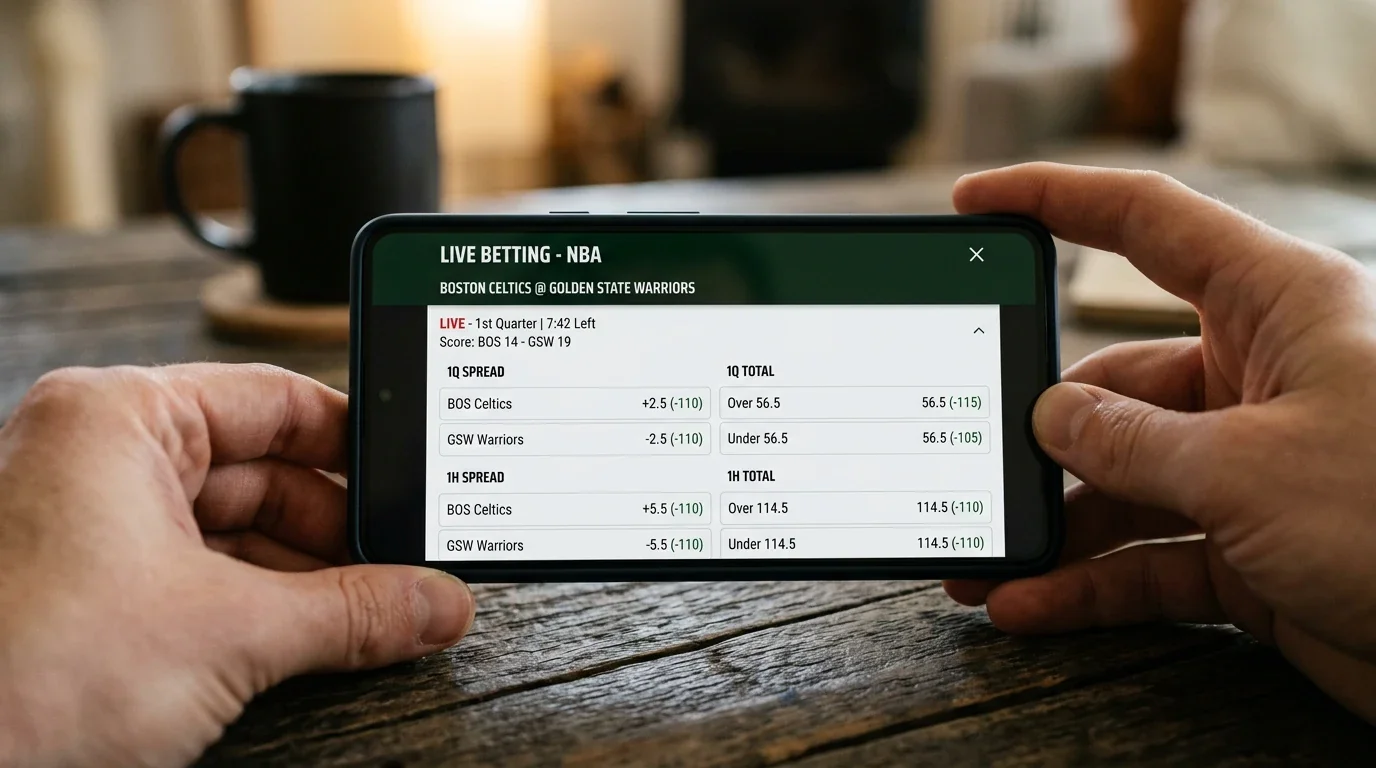
Short-Term Betting Models for Quarters and Halves
I once watched a friend lose his mind over a perfectly settled bet. He’d taken Boston −5 on the first half. Boston led by twelve at the buzzer. The bet won. He was convinced he’d been short-changed because the final score was a four-point Boston win after overtime. He spent ten minutes arguing with the bookmaker’s chat agent before I asked him to read the market title. First half. Twenty-four minutes. Nothing after halftime counted.
That’s the entire story of quarter and half markets. They’re not full-game bets cut into smaller pieces. They’re sealed boxes. The first quarter ends at the buzzer of Q1, and whatever happens in Q2 is irrelevant to that ticket. Same for the half. Same for individual quarters. Critically, overtime never counts in any of these markets – they cap at the regulation period in question.
UK liquidity on these markets is healthy. With 13.5 million active accounts at the largest UK online operators in early 2025, books carry full quarter slates on every televised NBA game. Sharper pricing arrives later in the day as injury news clarifies, and rotation patterns determine which side starts hot. If you understand which players the coach trusts in the opening five minutes versus the closing five, quarter markets become readable.
First-Quarter Markets
The first quarter is its own little game. Twelve minutes, starting lineups on the floor for most of it, no foul trouble adjustments, no late-game tactics. That’s why I look at it as the cleanest read of a coach’s preparation. Did the team practise the right offensive sets? Did they scout the opponent’s first-quarter defensive schemes? It shows up immediately.
The 1Q spread typically runs at about a quarter of the full-game spread, often a touch less. A full-game spread of −8 might map to a 1Q spread of −1.5 or −2. The 1Q total is roughly a quarter of the full-game total – a 224-point game might list at 56 or 56.5 for the first frame.
What sharpens a 1Q ticket is rotation knowledge. If a team’s bench is dreadful and the starters get a long opening run, the first quarter might be the strongest twelve minutes of the game for that side. If a coach famously rests the lead guard at the six-minute mark of Q1, that team’s offence dips in the back half of the quarter. The 2025-26 season pulled in 170 million viewers across US broadcasts, the highest in twenty-four years, which means more eyes are on opening quarters and the lines are tightening as a result. Soft pockets show up on early-week games and on West Coast late-tip slates that UK punters often ignore.
Halftime (1H) Markets and Adjustments
Halftime markets are the closest thing to a full-game bet you can place without worrying about overtime. Twenty-four minutes, full rotations, both starting fives plus the primary bench used for at least one stretch each. The 1H line behaves more like a scaled-down full-game line than the 1Q does.
What shifts during the half is the coaches’ adjustments at halftime – but those adjustments don’t help your 1H ticket. They only matter for the second half. So when you bet a 1H spread of −4 and the team leads by six at half, you’re done. The locker-room talk doesn’t reach into your bet slip.
I treat 1H markets as the place where my pre-game read is most cleanly tested. If I think team A is sharper, more rested and matched up well in the half-court, the 1H is where that view shows up earliest. If they’re going to fade in the second half due to depth issues or a back-to-back, the 1H captures my edge before the fade hits. The catch is the half-point hook on 1H lines feels more meaningful than on full games, because there’s less room for variance to bail you out.
The other wrinkle is the 1H total. Halftime totals tend to come in slightly under the implied half-of-full-game number because teams play more conservatively in the second quarter as fouls accumulate and the bench rotation eats minutes. A full-game total of 224 might list as 110.5 or 111 for the first half rather than 112. That two-point gap is the trader’s small bias, and over time it lines up with how the games actually play out.
3rd and 4th Quarter Markets
The third quarter is the most volatile twelve minutes in the NBA. Halftime adjustments take effect, the team that was getting beaten comes out swinging, the leading team comes out flat. I’ve seen 24-point first halves get turned upside down inside six minutes of Q3.
That volatility makes 3Q markets harder to read but also more rewarding. If you correctly identify the team that’s better-coached at halftime – the kind of side that consistently wins the second half regardless of the 1H scoreline – you can build a 3Q-only profile across a season. Some teams genuinely are 3Q teams. Others fall apart in the third frame and rally late.
Fourth-quarter markets are different again. The fourth quarter compresses into clutch-time tactics: intentional fouls, timeout management, isolation possessions for stars. The fourth-quarter total tends to be lower than the third-quarter total because of stoppage of clock and free-throw conversions. If you’re going to bet 4Q markets, do it on the games where you genuinely think one side closes well – not on the games where you think the spread is wrong but you want a smaller stake. For the related family of markets that derive from these segments – race-to-points, winning margin, method of victory – the breakdown in how NBA derivative markets work picks up where the standard quarter and half lines stop.
Why Overtime Doesn’t Count Here
Overtime is the most common cause of confused punters at UK books. The rule is simple but easy to forget: quarter markets and half markets settle on regulation only. If a game ends 110-110 at the end of the fourth and goes to overtime, the 4Q market settled when the buzzer hit, the 2H market settled at the end of regulation, and the full-game moneyline keeps running until somebody wins.
So a 2H spread that looks like a push at the end of regulation is exactly that – a push. The overtime bonus points don’t get added in. Your stake comes back. Same for the 4Q total: settled at the end of the fourth, no matter what happens after.
This catches casual bettors out repeatedly. The standard UK book terms and conditions are explicit about it, but most punters don’t read them carefully. The shortcut to remember is the time period in the market name. Quarter, half, half-time/full-time – these are all regulation-only by definition. Anything that says “match” or “game” includes overtime unless the bookmaker specifically flags otherwise.
One last piece of practical UK knowledge: live in-play markets often re-open quarter and half betting after the period ends if the next period hasn’t started. The system isn’t punishing late bettors; it’s just letting you bet the next twelve minutes as a fresh market. The lines reset, the prices reflect the current scoreline, and you can dive in with a clean slate.
Does a ‘1H spread’ include the second-quarter buzzer?
Yes. The first half ends at the buzzer of the second quarter, so the final whistle of Q2 is the settlement point for any 1H market. Anything that happens in the third quarter, fourth quarter or overtime has no bearing on a 1H bet. The score recorded at the halftime buzzer is the final score for that market.
What if a game ends in regulation but the 1H market said push?
A push on the 1H spread or total settles regardless of what happens later. If you bet 1H Boston −4 and the score at halftime was Boston by exactly four, your stake is refunded as a push. The fact that Boston eventually won by twelve in regulation, or that the game went to overtime, is irrelevant to the 1H ticket. Quarter and half markets are sealed at their respective buzzers.
Created by the ”how Does nba Betting Work” editorial team.