Betting on the NBA London Game: O2 Arena, Travel and Neutral-Site Lines
 Available in US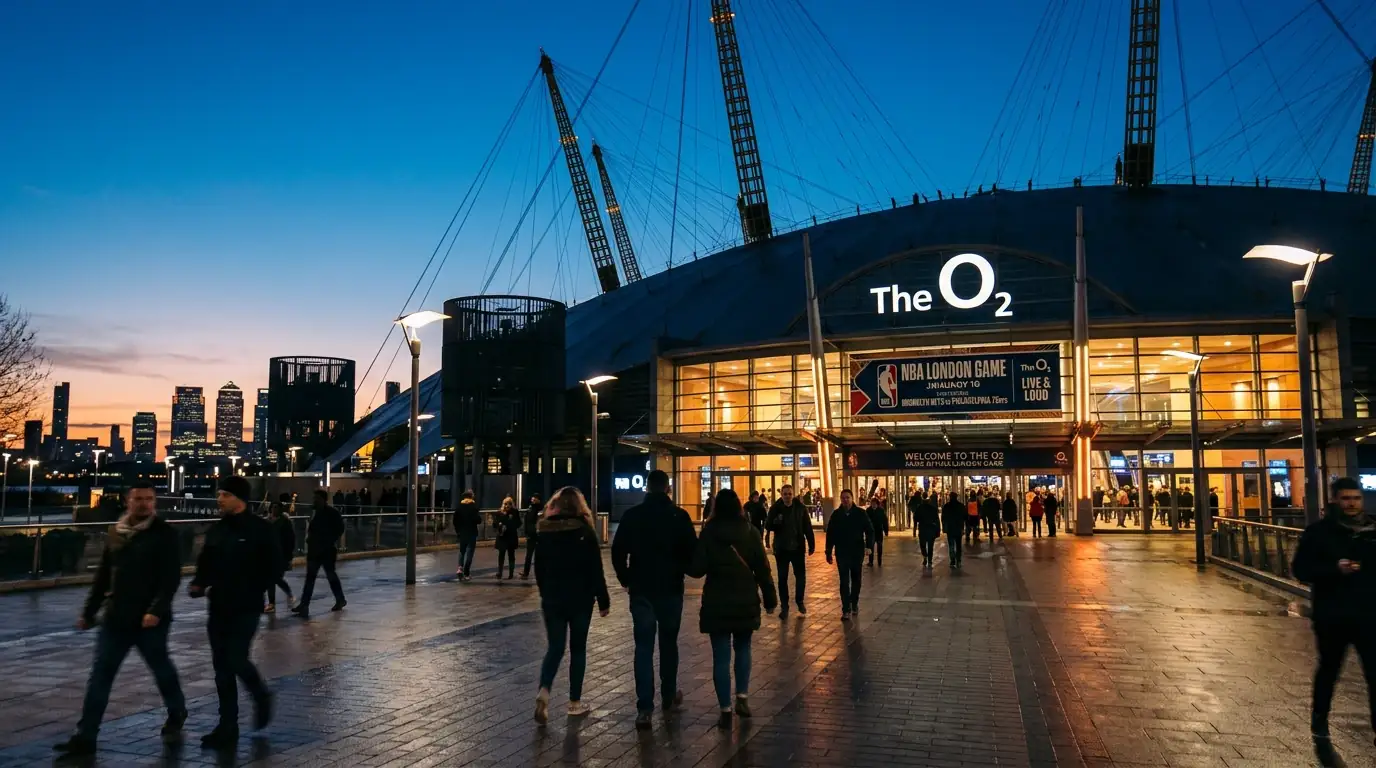
The One NBA Game That Lands at UK Tip-Off Time
The NBA London game is the only fixture in the regular-season calendar that tips off in the early UK evening rather than the small hours of the morning. For UK punters, that single timing fact reshapes the entire engagement profile. You don’t have to set an alarm or stay up past midnight to watch live. You can sit down with a takeaway at 7pm, follow the build-up across two pre-game shows, and bet the live markets as they develop in real time.
Operator data tells the story of how UK punters respond. Entain reported that recent UK basketball betting volumes have been “subdued in some segments compared to Germany and France” but the London game is the visible exception – a marquee fixture that pulls volume far above the typical regular-season game. Cross-channel comparison: Paris saw a 241% spike in NBA betting volume year-on-year in the lead-up to French NBA fixtures, and Berlin saw 274% growth around German fixtures. The continental pattern is clear, and the UK figure tracks similar dynamics for the London game.
The deeper context is that the NBA’s European expansion is now formal policy. NBA Europe is set to launch in October 2027 with 16 teams and a competition structure that will make European NBA basketball a year-round product rather than a one-off annual visit. The league has reportedly received over 120 investor bids to participate, which signals the depth of capital chasing the opportunity. London will be one of the major franchise locations, and the London game in its current form is the prelude to a multi-year expansion of the UK basketball product.
I’ll work through how to bet the London game specifically: the neutral-site adjustments that distort lines, the travel fatigue dynamics that shape player props, what UK handle data has shown for recent fixtures, and the trajectory towards NBA Europe that’s already changing how UK operators price the broader basketball market.
The Neutral-Site Adjustment
The London game is a neutral-site fixture in name and a quasi-home game in reality for whichever team has been designated the “host.” The mechanics matter for line interpretation. The home team’s branding shows on the floor, on the jumbotron, on the merchandise. The away team flies in two days earlier, runs through a media day, plays a single game, and flies straight back. The “home” team also flies in but gets the ceremonial trappings.
What this does to the spread is interesting. Pure home-court advantage in a US NBA game is worth roughly 2-3 points in long-run regression, depending on who’s running the model. The London game’s branded-home advantage is worth less – maybe 0-1 points – because the actual practical benefits of home-court (sleeping in your own bed, familiar venue, supportive crowd, no travel) are absent or diluted. The crowd element is the most interesting: the O2 crowd is genuinely neutral or even biased towards the more globally popular team, regardless of which side has the home jersey designation.
UK NBA bookmakers price this asymmetry imperfectly. Some operators apply a full home-court adjustment to the designated host. Others apply a partial adjustment. A few apply none. The variation across operators creates line-shopping opportunities – the same matchup with the same designated host can have spreads varying by 1-1.5 points across different UK books for the London fixture specifically.
The reason this matters is that the absolute point value at stake is meaningful. A 1.5-point spread differential at -110 odds shifts the bet’s expected value by several percentage points. Across the full betting volume the London game generates in UK accounts, that pricing variance is real money sitting on the table for any punter willing to compare lines across operators before placing their bet. The fundamentals of how NBA betting markets work and where the prices come from apply directly to the London game with the neutral-site adjustment as the dominant factor in interpreting the line.
One specific adjustment I track: the totals line on the London game has historically run a bit higher than equivalent matchups would in the US. The hypothesis is that the unfamiliar venue produces slightly less-tight defence in the early minutes, with both teams adjusting to the floor and the rims and the lighting. The data supports a modest over-bias in early-game scoring, though the effect washes out by the second half. Worth knowing if you’re betting first-quarter or first-half totals.
Travel Fatigue and Schedule Spots
Both teams in the London game travel further than any regular-season fixture asks of them. The transatlantic flight, the time-zone shift, the disruption to normal routines – none of that is fully priced into the line because there’s not enough historical data for the pricing models to calibrate against. Sample size on London games is tiny relative to US-based fixtures.
What we do know from related sports science is that long-haul flights produce measurable performance decrements, particularly in fast-twitch activities like jumping and lateral movement. Three-point shooting, defensive closeout speed, and rebounding contests are all affected. The effects fade across days but don’t fully clear within the 48-hour window between arrival and tip-off.
The schedule spot before and after the London game also matters. A team coming off a back-to-back at home then flying to London is in worse shape than a team coming off three days of rest. A team flying back from London to start a five-game road trip is in worse shape than one returning home. UK punters can use the surrounding schedule to gauge fatigue load that the spread may not fully reflect.
Player rest patterns specific to the London game are worth flagging. Some star players are openly rested by their teams for the London fixture – the trip is exhausting, the game doesn’t carry standings stakes meaningfully different from any other regular-season game, and load management calculations support sitting key players. Other star players treat London as a marquee opportunity and play heavy minutes regardless. Predicting which approach a given team will take requires watching the days leading up to the game closely.
For prop betting, the travel factor weights toward unders on player stat lines. Heavy minutes are less productive when the player is jet-lagged and out of routine. Three-point percentage drops modestly. Free-throw percentage holds roughly steady. Rebounding holds steady. Points totals trend slightly low against the season-average projections for many players in the London window.
What UK Handle Looked Like for January 2026
The January 2026 London game produced one of the largest UK betting handles for any NBA regular-season game in the modern UK regulated era. The data isn’t fully published yet – operators don’t release game-level handle figures publicly – but industry chatter and operator-side commentary have been clear that the volume was multiples of a typical UK NBA Tuesday night.
What drove the volume was a combination of factors. The 86% year-on-year viewership growth across the 2025-26 season meant a much larger pool of UK fans engaging with NBA content than in prior years. The 52% growth in NBA App users in the UK reflects a broader engagement curve. Marquee teams playing in London adds a star-power multiplier on top of the base. And the convenient UK tip-off time means recreational punters who don’t normally engage with NBA betting will fire a one-off bet on London because the access friction is low.
The handle distribution was interesting. Spread and moneyline accounted for the majority. Totals had unusually high volume relative to a regular-season norm, with both sides of the over/under attracting balanced action. Player props had higher volume than a typical regular-season game but lower than a marquee playoff game. Live betting volume during the London game was very high, partly because UK punters were actively watching rather than checking scores in the morning.
Operator pricing on the London game was unusually competitive. Margins on spread and total markets compressed in the days before the game as operators competed for handle, with the closing lines tighter than they would have been on a typical regular-season Tuesday. This is the kind of market where line-shopping pays the most, because the headline matchup attracts every operator’s pricing attention and the small differences across books are visible.
For UK punters who treat the London game as their entry point to NBA betting, the handle data also suggests caution about extrapolating. The volume on London is anomalous. Tuesday-night non-marquee games produce a fraction of London’s volume, and the pricing for those games is correspondingly less competitive. Building a season-long process means engaging with the un-marquee games where the operator’s pricing margin is wider but the customer’s read can produce higher relative edge.
NBA Europe and the London Franchise
NBA Europe’s October 2027 launch is the structural change that will reshape UK NBA betting more than any single event of the past decade. The league has confirmed 16 teams in the initial structure, with London expected to host one of the franchises. The 120-plus investor bids the NBA has fielded reflect the breadth of capital chasing European basketball positions, and the resulting competitive equilibrium will determine the level of play and the betting markets that surround it.
For UK punters, the implications are direct. A London-based NBA Europe team means home games at UK venues throughout the season – multiple games per week during the autumn and winter, with full European travel schedules and the kind of regional rivalries that build sustained betting interest. The market structure will look more like Premier League football than the once-a-year visit pattern of the current London game.
UK operator pricing infrastructure will follow the volume. Pricing models will need to handle European-quality basketball with European travel and rest patterns. Live in-play products will adapt to UK-evening tip-offs as the dominant pattern rather than the rare exception. Player prop markets will deepen as the player pool establishes betting-relevant track records.
The handicapping skills that work for the current NBA London game will transfer cleanly to NBA Europe – neutral-site analysis becomes home-and-away analysis, travel fatigue becomes route-and-rest analysis, and the basic probability frameworks remain identical. What changes is the volume and the variety of markets available, which translates into more opportunity for customers willing to specialise.
The transition window between now and October 2027 is also an opportunity. UK operators will be building NBA Europe pricing infrastructure during 2026 and 2027, and the London game in its current annual form is partly a testbed for the larger product. Customers who develop fluency with London-game betting now will have a head start when the European league launches and the markets become more sophisticated.
Treating It as Part of the Season Rather Than the Whole
The London game is exciting and the volume reflects that. Where UK punters lose value is treating it as a special-occasion bet rather than as one game in a long season. The same disciplines that produce profitable NBA betting across the broader calendar apply to London. The neutral-site adjustment is just another input. Travel fatigue is just another factor. The convenient UK tip-off time is a perk for the customer experience, not a signal about how to bet differently.
For UK NBA punters who want to engage with the London game seriously, my approach is straightforward. Track the lineups in the days leading up. Watch which players are confirmed as travelling and which are listed as questionable. Compare lines across operators because the variance is wider on this game than on most. Apply a modest neutral-site adjustment, a modest travel-fatigue adjustment on prop unders, and otherwise use the same handicapping framework you’d apply to a US-based game.
The London game is a test case for the bigger NBA Europe product arriving in 2027. Treating it as practice for that future market – building habits, refining process, learning the operator-side pricing patterns specific to neutral-site and European fixtures – is the highest-value use of the engagement opportunity it provides.
Does playing in London actually shift the spread?
Modestly, yes. The designated home team’s branded home-court advantage is worth roughly 0-1 points in spread terms compared to a typical 2-3 point home edge in the US. UK operators apply this adjustment with some variation, which produces line-shopping opportunities across books. Travel fatigue affects both teams, with the team flying further or coming off less rest carrying the larger negative adjustment in pricing models that handle it explicitly.
How will NBA Europe affect London-based betting markets?
NBA Europe’s October 2027 launch with 16 teams will transform London-based betting from an annual marquee fixture into a season-long product with multiple games per week. UK operators will build deeper pricing infrastructure, more live-in-play markets, and more player props as the player pool establishes betting-relevant track records. The handicapping skills from the current London game will transfer directly, with home-and-away analysis replacing neutral-site analysis as the dominant framework.
Created by the ”how Does nba Betting Work” editorial team.