Reading NBA Live Line Movement Without Tilt
 Available in US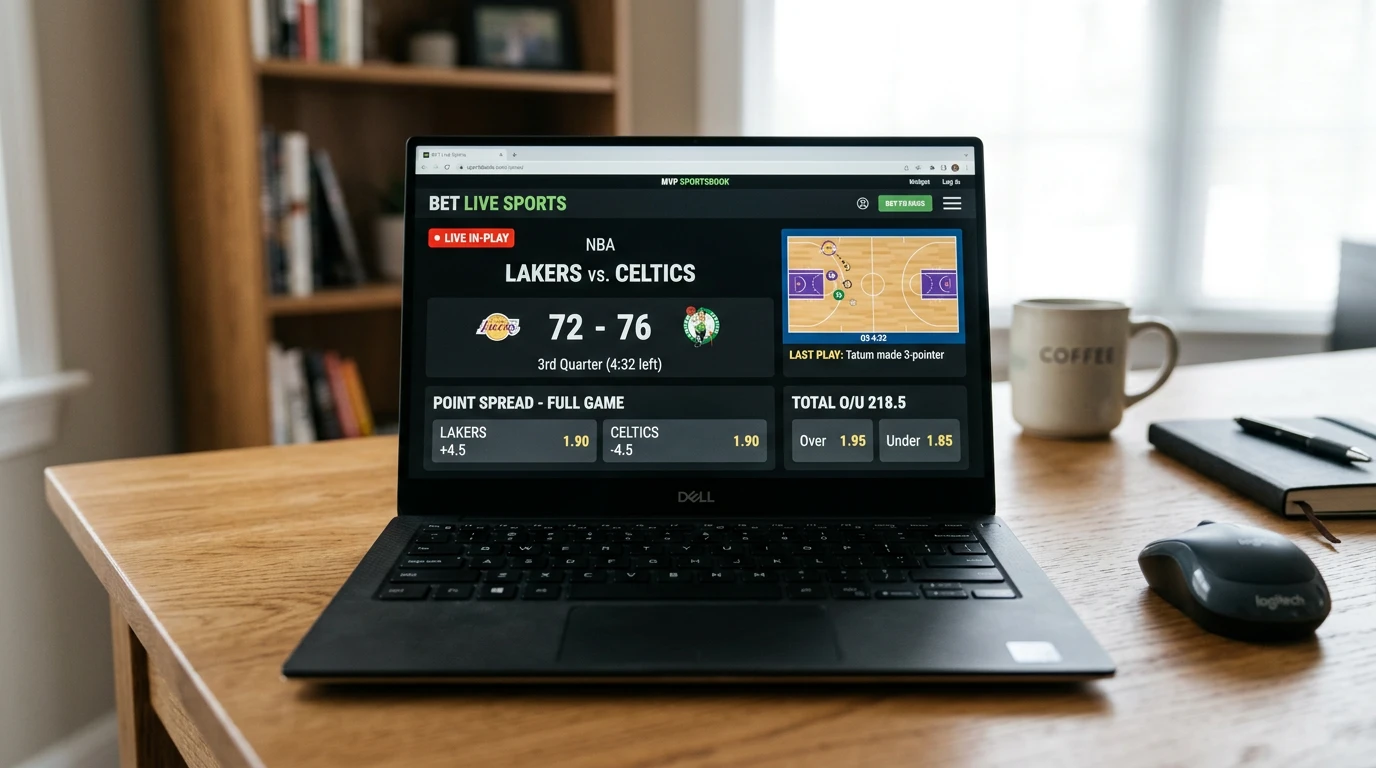
Why a Three-Point Spread Becomes Six in Forty Seconds
I was watching a Pelicans-Magic game in mid-November when the live spread did something that made me write notes for an hour afterwards. Game tipped at Pelicans -3.5. Magic hit two early threes, the score sat at 8-2, and the live spread snapped from -3.5 to Pelicans pick’em – a three-and-a-half point swing on six points of game action. Forty seconds of basketball, three and a half points of line movement. The model wasn’t wrong; it was reacting to win-probability inputs that included possession arrow, foul trouble probability, scoring pace and the bench rotation about to enter. To a casual viewer, the line moved violently. To the model, it moved exactly the right amount.
UK NBA live markets get to that level of responsiveness because the underlying pricing engines run sub-second updates, querying the game state, the win-probability curve, and the implied price every time a possession ends. The output sits on your screen as a single number, but the input stack is dense. Most punters watching the line move don’t see the inputs – they see the number jumping and they assume noise.
The 13.5 million UK active gambling accounts are a meaningful audience, and a growing slice of that volume now runs through live in-play markets where line movement is the central variable. The 170 million NBA viewers across the 2025-26 season – an 86% jump on the prior year – adds the eyeballs that turn live volume into a serious revenue line for UK operators. Reading line movement properly is the highest-leverage skill in live betting, and it separates customers who survive in-play markets from those who get systematically chewed up.
I’ll walk through five concrete pieces: what model lines are doing versus game flow, how foul trouble distorts pricing, the momentum trap that catches recreational bettors, and how to use a meaningful move rather than chase it. None of this is theory – it’s the vocabulary I use when I’m making live decisions, and the framework that’s saved me from a lot of expensive taps.
Model Lines vs Game Flow
Every live NBA spread you see is two things at once. It’s the model’s view of the win probability and remaining game pace – a “fair” line based on calculated inputs. And it’s the operator’s market reaction to public action and incoming bet flow – a “market” line that tilts towards balancing the book.
The fair line moves on game inputs. Possessions completed. Score differential. Pace of play. Foul totals. Time remaining. The fair line is what the model would say the spread should be if only the game state mattered. It’s a clean number reflecting the residual basketball still to be played.
The market line moves on game inputs plus action flow. If 80% of customers backed the favourite live and the action keeps coming on the favourite, the operator widens the spread on the favourite to attract counter-action – even if the fair line says the original spread was correct. The market line is a fair line plus a balancing nudge.
The gap between fair and market is where live edges live. When you see a live spread that’s wider than the fair value implies – a favourite at -8 when the fair line is closer to -5 – the operator is paying you to take the underdog. When the spread is narrower than fair – a favourite at -3 when the fair value is -6 – the action has piled on the favourite and the operator is offering a haircut to attract dog money.
Reading this gap requires a model – even a rough one – for what the fair line should be. Most UK punters don’t have a quantitative model running. What you can do without one is track historical relationships: a 10-point lead with 6 minutes remaining typically corresponds to a particular fair-line band. A possession arrow plus a transition basket compresses or expands that band predictably. Build the heuristic up over a few weeks of game-watching with a notepad, and you’ll have a rough internal model that flags when the live spread feels off.
Real-event in-play GGY climbed 16% year-on-year in the most recent UK quarter, and the volume growth means more action is hitting live markets, which generally means more market-line distortion relative to fair value. That’s where the customer skill matters more than ever.
Foul Trouble and Star-Player Risk
Foul trouble is the input that distorts live NBA spreads more than any other single variable, and it’s also the one most consistently mispriced in my experience. Three fouls on a star player with five minutes left in the second quarter is a non-trivial event for the model, but the scale of the move you see depends on how the operator’s engine handles it.
The base maths is clear. A star player with three first-half fouls is at meaningful risk of fouling out before the fourth quarter, which removes their production from the closing minutes – exactly when their efficiency tends to be highest. The fair-value spread should widen against their team by some amount that depends on the player’s importance to the team’s overall production.
What I see in UK live markets is consistent over-reaction on second-tier teams and under-reaction on first-tier teams. When a top-five MVP candidate picks up a third foul, the spread moves further than the fair value supports, because public action piles on the over-reaction and the operator follows the action. That’s a fade spot if you can stomach the live entry. When a third or fourth banana on a contender picks up the same third foul, the spread barely moves, because the public doesn’t track the player closely enough to react. That’s an entry on the side that benefits.
The asymmetry runs in another direction too. Foul trouble in the second quarter has substantially less expected impact than foul trouble in the third, because second-quarter foul trouble is more likely to be managed with an early bench rotation that the team would have done anyway. Third-quarter foul trouble forces the player to sit longer than the rotation plan, and the team plays bigger minutes without their star.
UK books vary in how their pricing engines weight these distinctions. Some are sharp and the live spread reflects the timing context. Others apply a flat foul-count penalty regardless of when in the game it happened. Watching enough live markets at your operator of choice gives you a feel for which model they’re running, and where the predictable mispricings sit.
The Momentum Trap
The momentum trap is the single biggest leak in recreational live NBA betting. A team makes a 9-0 run, the live spread snaps in their favour by 4-5 points, and the punter watching backs them at the new line because “they’re hot.” The team comes back to the mean, the run ends, and the bet sits underwater within four minutes of placement.
Basketball runs are roughly mean-reverting on short timescales. A team capable of producing a 9-0 run in a single possession sequence is also capable of giving back six of those points to the opposing team across the next two minutes. The model knows this; the punter chasing the run typically doesn’t.
The cleanest illustration: pace-adjusted scoring per possession is roughly stable across each team’s average. A team running at 1.10 points per possession isn’t going to run at 1.30 across a four-minute window for any structural reason – they hit a hot stretch within the natural variance of their average. The fair-value line adjusts only modestly because the model averages across longer time windows than the human eye does.
What chasing momentum does is convert variance noise into a bet at a worse price. You’re paying the post-run inflated spread for an outcome that’s mostly a regression bet against the run. The expected value is negative on most of these entries, and the cumulative season cost across a season’s worth of momentum chasing is significant.
The discipline is to wait for the regression. When the run ends and the line drifts back, that’s the entry – if you have a view on the underlying matchup that the run obscured. A team that was a fair-value 7-point favourite pre-game and is now showing as a 3-point favourite after a brief opponent run is potentially a value entry. The momentum-chase impulse points the wrong direction, and resisting it is the bedrock skill of live NBA betting.
Using a Move Instead of Chasing It
The right way to use line movement is as a signal, not as a stimulus. A meaningful move tells you something about how the market sees the game state. Your job is to interpret the signal, weigh it against your own view, and act when the gap between market and your view is large enough to clear the operator’s margin.
Three signals worth tracking. First, sustained directional drift – the line moving steadily one way over multiple possessions, not snapping back. That’s usually action-driven rather than game-driven, and it’s a soft contrarian signal. Second, sharp counter-moves – the line moving against the visible game flow. That’s usually informed money entering, and it’s a soft confirmation signal for the side the line is moving towards. Third, frozen lines during action moments – the operator suspending or barely moving the line during a possession that visibly changed the game state. That’s a sign the model needs more data and isn’t yet pricing the change.
None of these signals are clean. The market is noisy, your read is imperfect, and your stake is real money. The skill is layering the signals against the rest of your live-betting process. How NBA live player props work in the UK market is a related skill set – the same line-reading discipline applies to live prop markets, just with different inputs and a different volatility profile.
The cleanest mental model I use: the live line is a probability statement, and your bet is a counter-probability statement. If the live spread implies 70% favourite probability and your read says 60%, you back the underdog. If the implied probability matches your read, you skip. The arithmetic is simple. The reading skill that produces your read is everything.
One closing note on the 13.5 million UK gambling accounts: most of them aren’t doing this work. They’re tapping live buttons because the game is exciting and the option is there. The ones who treat live markets as a craft – building heuristics, tracking moves, separating signal from noise – make up a small minority of the live volume. The competitive structure of in-play betting rewards exactly that kind of patience. The opportunity in live NBA markets is real, even after the operator’s margin is paid.
What Survives the Variance
Line movement reading is a skill that takes seasons to develop, and most of the development is unlearning the instincts the casual punter brings to a live screen. The sharp move you want to chase usually isn’t the one to chase. The frozen line you want to ignore is sometimes the one to engage.
The way through is treating live betting as a process rather than a series of impulses. Have a view before you place the bet. Validate the view against the line. Skip the bet if the line and the view agree. Take the bet if the line is meaningfully off your view. Track outcomes against your views over time, not against the bet results – the bet result is luck-laden noise across any short sample, and the view-versus-line accuracy is the underlying signal that tells you whether your live betting process is profitable in expectation.
Most UK NBA bettors who try live markets quit within a few weeks. The minority who stick with it and build the process tend to find live markets more profitable than pre-game over time, because the operator’s margins on live markets are sometimes wider but the customer skill differential is much wider still. The gap between the disciplined live bettor and the impulsive one is bigger than the operator’s margin, which is why the discipline pays.
Does a live spread always reflect win probability?
Roughly, yes – the live spread is the operator’s pricing model’s best estimate of the fair line given current game state, plus a margin nudge to balance action flow. The mapping isn’t exact because the operator factors customer behaviour into the line. But the relationship between live spread and win probability is direct enough that you can use one to estimate the other when comparing your own read against the market.
How fast does a UK book react to a star sitting on the bench?
Modern UK pricing engines react within seconds of a substitution being recorded in the operator’s data feed. The line shift on a star going to the bench is typically priced in within one possession. The lag matters most on stars with high foul trouble probability, where the operator may pre-emptively widen the spread on the team’s side ahead of an expected substitution.
Prepared by the how Does nba Betting Work editorial staff.