Fractional and Decimal Odds: Reading NBA Betting Prices
 Available in US
Table of Contents
- Odds Formats Comparison: UK Bookmaker Display Types
- Decimal Odds: The UK Default
- American Odds: Plus, Minus and the −110 Standard
- Fractional Odds: The High-Street Heritage Format
- Converting Between Formats Without a Calculator
- Implied Probability: Turning Odds into Win Chances
- The Vig: How Bookmakers Build Their Margin
- Calculating a No-Vig Fair Line
- Line Shopping Across UK Books
- Closing Line Value: The Sharp Bettor’s Yardstick
- NBA Odds: Quick Answers
Odds Formats Comparison: UK Bookmaker Display Types
The first time I opened a UK sportsbook on an NBA game, I had three numbers in front of me and could only properly read one of them. The American line said −165. The decimal said 1.61. The fractional said 8/13. They were all the same price. They all looked different. And nothing about the website explained which one to use.
That was 2014. The situation has not changed much. Every UK sportsbook still lets you toggle between the three formats, and most NBA punters in Britain switch between two of them on the same betslip without realising it. Decimal is the UK default. Fractional is the format your dad uses in the bookies. American is what the entire NBA broadcasting ecosystem talks in, which means every prop preview, every podcast, and every Twitter account uses minus and plus numbers when they discuss prices.
The point of this article is to make all three formats fully transparent — so you can read American odds at a glance, convert them to decimal in your head, work out implied probability without a spreadsheet, and understand the vig the bookmaker is charging on every NBA market you touch. The maths is not hard. The notation is what trips people up. By the end, the maths underneath will feel obvious, not the format chosen to display it.
One thing to set straight before we go further. Odds formats are display conventions. They do not change the price. A bet at −110 American is identical to 1.91 decimal is identical to 10/11 fractional. Same payout, same risk, same expected value. The only thing that changes is how easy the number is to read for the use you have in mind. Decimal is best for fast multiplication of stake. American is best for thinking in implied probability. Fractional is best for nostalgia.
Decimal Odds: The UK Default
Decimal odds answer the question every UK punter actually wants answered: how much money comes back if I win. The number is the multiplier. Stake times decimal odds equals total return, including your stake. A £20 bet at 2.50 returns £50 — that is £30 of profit and your £20 back.
That is the entire formula. There is no second step, no fraction to flip, no plus or minus to interpret. Which is why every modern UK betting app defaults to it and why, after a decade of working with NBA markets, I still keep my own logs in decimal even when I am thinking in American.
NBA-specific decimal numbers cluster predictably. A near-pick’em moneyline lives at 1.91 on each side. A modest favourite sits around 1.55; the corresponding dog sits near 2.50. A heavy favourite drops below 1.25, with the dog at 4.50 or higher. Spreads and totals at −110 American show as 1.91 in decimal almost universally across UK books.
The strength of decimal goes beyond payout calculation. It is the only format where comparison is intuitive. 1.91 is clearly worse than 1.95 on the same bet — the higher number always pays more. Compare that to fractional, where deciding whether 10/11 is better than 19/20 requires actually doing the maths. Or American, where moving from −110 to −108 sounds like a worse number but is actually a better price.
The UK sports betting market is forecast to grow at a compound annual rate of around 11.4% through 2030, and one of the underappreciated drivers of that growth is the user-friendliness of decimal odds for casual bettors crossing over from football and cricket. New punters trying the NBA for the first time can read a decimal price without instruction. They cannot read American or fractional without help. That accessibility matters when the menu is as deep as the NBA’s now is.
One small wrinkle. Decimal odds always include the stake in the return. This is different from how some UK punters mentally calculate fractional odds, where the fraction tells you the profit only and the stake is added separately. If you are switching from fractional to decimal, the most common error is to expect the decimal payout to be on top of your stake. It is not — it is the total. Burn that in early.
American Odds: Plus, Minus and the −110 Standard
The first time I had to call out an NBA price live on a podcast in 2018, I froze. The host had said “−175 on the Lakers, what do we think?” and my brain — which had been running pure decimal for years — needed a hard second to recall that meant a stake-£175-to-win-£100 favourite. American odds force a different cognitive shortcut, and once you build it, you stop being lost.
American odds run on a £100 anchor. A negative number — say −175 — tells you how much you must stake to win £100 in profit. So −175 means stake £175 to win £100. A positive number — say +150 — tells you how much you win on a £100 stake. So +150 means stake £100 to win £150 in profit. Pick’em sits around −110 on each side.
The £100 figure is just a reference unit. Stake whatever you like — the proportion stays the same. A £20 bet at −175 wins £20 × (100/175) = £11.43 in profit. A £20 bet at +150 wins £20 × (150/100) = £30 in profit. Same arithmetic, scaled.
The reason American odds dominate NBA discourse is simple: this is an American sport. Every analyst, every public model, every Twitter account quotes prices in American format because that is what the US books and major US data providers use. The American market is the deepest legal sports betting market in the world — the total US legal handle was $147.9 billion in 2024 — and roughly thirty-two percent of that volume runs through basketball alone. When sharps and sharps-adjacent commentators talk about NBA prices, they are talking American.
The −110 standard appears constantly in spread and total markets because it represents the bookmaker’s preferred vig structure on a balanced market. In decimal terms, −110 is 1.91. Two sides at −110 price out to a combined implied probability of about 104.8%, which means the bookmaker has built in roughly 4.55% of margin. The depth of that specific number’s role in NBA spreads is worth its own deep dive — most of the market lives around it.
The cognitive shortcut that finally made American odds click for me, after months of sluggish conversion, was thinking of the minus sign as “stake to win 100” and the plus sign as “win on 100.” Once those two meanings were instant, the rest of the format fell into place. The maths is no harder than decimal — the notation just demands a different reading habit. Build the habit on a fortnight of NBA cards and you will read both formats at the same speed.
Fractional Odds: The High-Street Heritage Format
Walk into any independent UK bookies on a Saturday and the prices on the board are still fractional. Walk into the back office of any modern UK app and the data is decimal. The fractional format is the Queen’s English of UK betting — heritage, instantly recognisable, and not the format any sane person uses for calculations.
The fraction reads as profit-to-stake. 5/2 means £5 of profit for every £2 staked — so a £10 bet returns £25 (£10 stake + £25 profit, total return £35). 1/4 means £1 of profit for every £4 staked — a £20 bet returns £25 total (£20 stake + £5 profit). The fraction is profit-only; you must add the stake back to know your total return.
NBA spreads at −110 American render as roughly 10/11 fractional. The number is not pretty because −110 does not reduce to a clean fraction. UK books sometimes round to 9/10 or 19/20 for display, which can mean a microscopic difference in payout. For a £50 stake, the gap between 9/10 and 10/11 is about a penny on the return. Real money over a season, but not enough to swing a single bet.
The honest verdict on fractional in NBA: avoid it. The format was designed for horse racing, where prices are wide enough that crisp fractions communicate value cleanly. NBA spread and total prices live in a narrow band around −110, where fractional notation produces visually awkward numbers like 10/11 and 19/20. You will have a much easier time keeping track of edge and value in decimal — and almost all NBA prop preview content from the US uses American — so fractional becomes a strict middle ground that no one prefers for anything specific.
Converting Between Formats Without a Calculator
Conversion between formats sounds intimidating until you realise there are exactly four arithmetic moves you ever need. Memorise these and you will never reach for a converter app again.
From American to decimal: if the line is negative, divide 100 by the absolute value, then add 1. So −175 becomes (100 ÷ 175) + 1 = 1.571. If the line is positive, divide the number by 100, then add 1. So +150 becomes (150 ÷ 100) + 1 = 2.50.
From decimal to American: if the decimal is below 2.00, the American line is negative, calculated as −100 ÷ (decimal − 1). So 1.61 becomes −100 ÷ 0.61 = −164. If the decimal is above 2.00, the American line is positive, calculated as (decimal − 1) × 100. So 2.50 becomes 1.50 × 100 = +150.
From fractional to decimal: divide the numerator by the denominator and add 1. 5/2 becomes (5 ÷ 2) + 1 = 3.50. From decimal to fractional: subtract 1 from the decimal, then express as a clean fraction. 2.50 becomes 1.50 = 3/2.
The shortcut I use to read American moneylines fast: −200 is exactly decimal 1.50, and +200 is exactly decimal 3.00. Anchor those two and you can interpolate everything else within a few seconds in your head. −150 is just south of 1.67; −110 hovers just below 1.91. Build a mental table of these anchors and the format becomes invisible. The maths is the same; only the notation differs.
Implied Probability: Turning Odds into Win Chances
The most useful thing odds tell you is not how much you win — it is how often the bookmaker thinks you win. Every price hides a probability inside it, and once you see that probability you stop arguing with the price and start arguing with the assumption behind it.
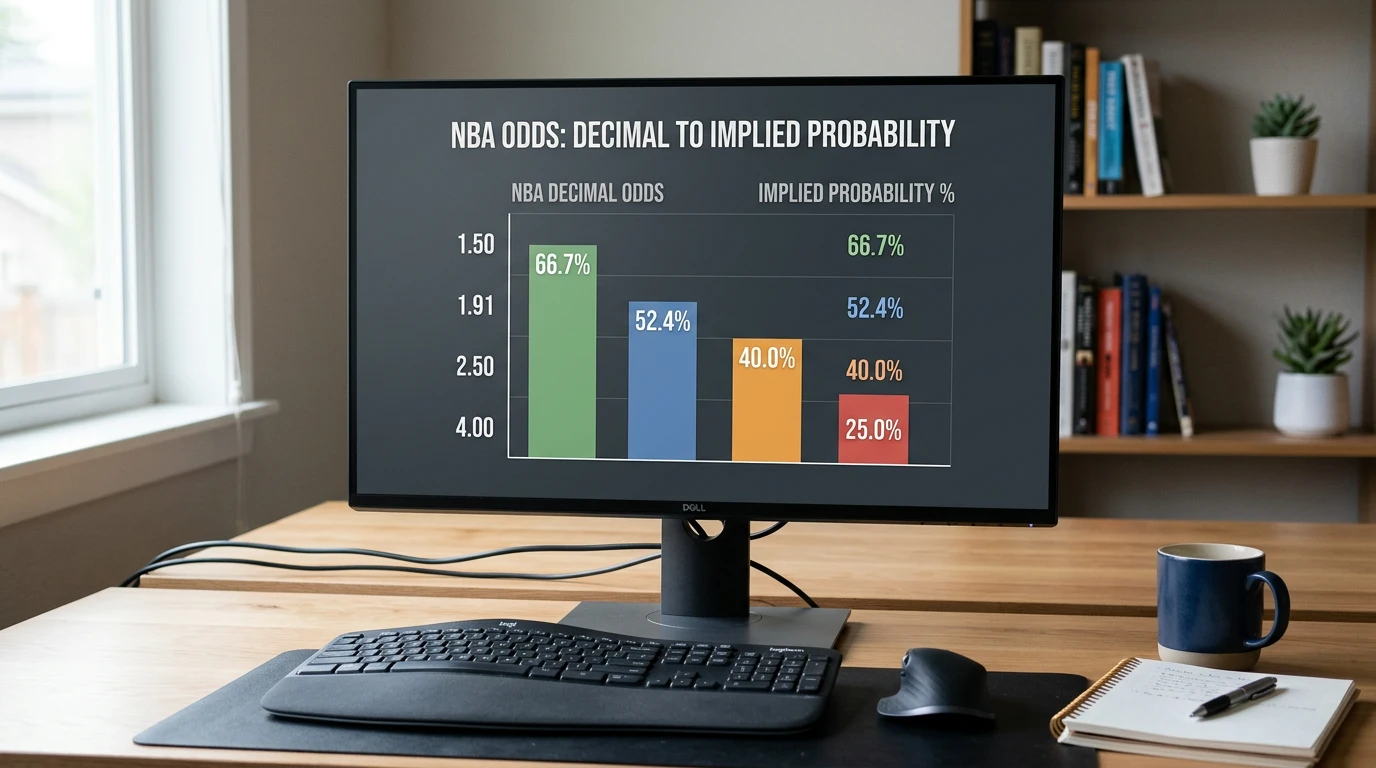
The conversion is one line of arithmetic. Implied probability equals one divided by decimal odds. So a price of 1.91 implies 1 ÷ 1.91 = 52.4% probability. A price of 2.50 implies 1 ÷ 2.50 = 40%. A price of 1.25 implies 80%. The bookmaker is telling you, in plain percentage terms, how often this side needs to win for the bet to break even.
From American odds, the conversion is two-step. For negative lines, implied probability is the absolute value divided by the absolute value plus 100. So −175 implies 175 ÷ 275 = 63.6%. For positive lines, implied probability is 100 divided by the line plus 100. So +150 implies 100 ÷ 250 = 40%. Same logic, different formula because of the asymmetric notation.
Here is where this matters in practice. The reason you bet a particular side is, at root, a disagreement with the implied probability. If the price says 40% and you think the true probability is 47%, you have positive expected value. If the price says 40% and you think it is 35%, you should not bet — even if you “feel” the side will win. Probability is the language of edge, and odds are the dictionary.
One trap to avoid. The implied probabilities for both sides of a market always add up to more than 100%. A typical NBA spread at −110 on each side gives 52.4% + 52.4% = 104.8%. The extra 4.8% is the vig — the bookmaker’s margin baked into the prices. To estimate true probability, you need to strip the vig out, which is the next move.
The discipline of running every NBA price through this conversion will change how you read a betslip. A heavy favourite at −500 implies 83.3% — and that needs to feel right to you before you stake. A long-shot dog at +450 implies 18.2% — which is a one-in-five-and-a-half chance, far less generous than the plus-sign instinct suggests. Numbers are honest. Vibes are not.
The Vig: How Bookmakers Build Their Margin
I once had a long argument with a friend who insisted bookmakers “lose money sometimes” and that was why they were trustworthy. He was half right and entirely wrong. The bookmaker can lose on individual games. The vig ensures they cannot lose on the long run, and the NBA is one of the most reliable vig-collection vehicles they operate.
The vig — also called juice, or the overround in UK industry language — is the margin built into prices. On a balanced two-way market like an NBA spread, a fair pair of prices would each imply 50%, totalling 100%. Real prices imply more than 100% combined. The difference is the vig. Two sides at −110 imply 104.8% combined; the vig is 4.55% per bet (calculated as the overround minus 100, divided by the overround). Multiply that across enough bets and the bookmaker has a margin that the law of large numbers turns into reliable revenue.
NBA spread and total markets typically run between 4% and 5% vig per side at the largest UK books. Heavily traded games on flagship slates can compress to 3.5%. Less liquid markets — quarter and half splits, derivative markets, niche player props — stretch to 6% or more. The pattern is consistent: more action, lower vig; less action, higher vig. The bookmaker prices against the risk of imbalance and the cost of the position they have to hold.
Moneyline vig works the same way but looks different in the numbers. A pick’em moneyline shows two sides at −105 or −110 — same 4–5% vig structure. A heavy-favourite moneyline shows asymmetric prices like −500 against +380, which still hides roughly 4–5% of vig, just distributed differently across the two sides. The maths is the same; the visual is misleading because the favourite price absorbs more of the margin in absolute terms.
The scale of NBA betting in the UK is part of why this margin matters. The total UK General Betting Duty rose to £714 million in fiscal year 2024–25, and the wider Remote Casino, Betting and Bingo sector posted gross gambling yield of £7.8 billion for the same period — a 13.1% year-on-year jump. Some non-trivial slice of that flow is NBA, and every pound of it crosses a price with vig attached. Margin is invisible until you measure it. After that, it is the first thing you check.
The practical upshot for a UK NBA punter: if a market is showing combined implied probability of 108% or more, the price is unusually expensive and you should think hard before staking unless you have a strong edge. If you can find a flagship-game spread at 102.5% combined, that market is competitively priced, and your edge has more room to operate. Vig is a tax. Like every tax, it compounds quietly across the bets you do not check.
Calculating a No-Vig Fair Line
If the implied probabilities add up to more than 100%, there is a clean way to back out what the bookmaker thinks the real probability is. Take each implied probability and divide it by the sum of all the implied probabilities on that market. The result is the no-vig fair line — the bookmaker’s view of true probability, with the margin stripped out.
Worked example. Boston −7.5 at −110, Chicago +7.5 at −110. Both sides imply 52.4%. Combined: 104.8%. Strip the vig: 52.4 ÷ 104.8 = 50.0%. The bookmaker’s true view is that this is a coin flip — the spread is exactly the right number, and any deviation from 50/50 in your own model is your edge.
Asymmetric example. Lakers −4.5 at −115 implies 53.5%; Bulls +4.5 at −105 implies 51.2%. Combined: 104.7%. Lakers no-vig probability: 53.5 ÷ 104.7 = 51.1%. Bulls no-vig probability: 51.2 ÷ 104.7 = 48.9%. The bookmaker thinks the Lakers cover slightly more often than the Bulls do, even though both sides are priced near pick’em. The half-point of asymmetry in the price is the bookmaker leaning on a soft side of the market.
The reason this calculation matters: it is the only honest comparator for your own probability estimate. If you think the Lakers cover 55% of the time and the no-vig fair line says 51.1%, you have an edge of about 4 percentage points. If you think they cover 52% and the no-vig says 51.1%, you are essentially staking on noise — your edge is too thin to overcome variance, no matter how confident the gut feels.
Sharp NBA punters run no-vig calculations on every market they take seriously. The number is not magic. It is just the bookmaker’s price stripped of the margin tax. Comparing your model to that number, rather than to the raw price, is the difference between betting on edge and betting on hope.
Line Shopping Across UK Books
Two quid here, three quid there. Over a season of NBA betting, the difference between a punter who line-shops and one who does not can be hundreds of pounds, even with identical pick selection. This is the most boring and most reliable edge available to a UK NBA bettor.
Line shopping means having an account at three or four UK sportsbooks and checking the price on the same bet across all of them before staking. The bookmakers do not coordinate their lines. Different liability profiles, different models, and different action mean their prices on the same NBA spread or moneyline will routinely differ by 5–10 cents in American terms — sometimes more. On a £100 bet, a price improvement from −115 to −105 is worth nearly £9 of profit on the same winning result. Repeat that across a season and the maths writes itself.
The most consistent gaps in my experience: spread prices on second-tier games (think Wednesday-night Eastern Conference fixtures) where one book has more action than another, total prices on back-to-back nights when one operator has not adjusted yet, and player prop markets where pricing models differ widely between books. Flagship games — Lakers, Celtics, Warriors at home — tend to compress to similar prices across all UK books because the liquidity drives convergence. The edges live in the middle of the slate.
One nuance specific to UK punters. Not all UK books carry the same NBA depth. Some show only main markets (moneyline, spread, total) and a thin prop list. Others publish dozens of derivative and prop markets per game. For derivative and prop hunting, you want at least one book with a deep menu plus one or two with main markets only — the deep book gives you the choice, the main-market books give you better prices on the headline lines because their prop liability is lower. The mix matters.
The discipline I impose on myself is simple. No NBA bet leaves my account without a line-shop on at least two other operators. Sometimes I find no improvement and stake at the original price. Sometimes I find a 3-cent gap and capture the value. Either way, the habit is what counts. Edge does not arrive in big lumps. It accumulates in increments you choose to capture or ignore.
Closing Line Value: The Sharp Bettor’s Yardstick
Of all the metrics I have tracked across a decade of NBA betting, closing line value is the one that has actually predicted long-run profit. Win rate is noisy. Yield is noisy. But beating the closing line — over a sample of more than a few hundred bets — correlates almost one-to-one with whether you finish the season ahead.
The concept is straightforward. The closing line is the price the market settles at just before tip-off. It is, on average, the most accurate prediction of the outcome that exists for that game. If you bet a side at +3.5 and the closing line moves to +2.5, you have positive closing line value — you got a better number than the market eventually agreed was fair. If you bet at +2.5 and the close is +3.5, you have negative CLV.
The reason CLV predicts profit is that the closing line is sharper than your bet, on average. If you consistently get to a number better than the close, you are consistently right about something the market only realised after you. Over time, that pattern produces winning bets at a rate above the implied probability of the prices you took. The maths does not care about how you found the edge — it only cares whether you found it.
For a UK NBA punter, tracking CLV means logging two prices for every bet: the price you took and the closing price at the same book. Many bookmakers do not display the closing line in your bet history, which is annoying but not fatal — you can screenshot the line at tip-off, or use a third-party odds tracker that records closes across multiple books. Once you have the data, you compare. Average CLV across 100+ bets above 0% means you are likely an edge bettor. Below zero means you are paying the bookmaker a tax on top of the vig.
The wider context for CLV in the UK reflects how the betting menu has expanded. Andrew Rhodes, chief executive of the Gambling Commission, has noted that operators are widening their sports offering, with sports beyond the traditional horseracing and football growing in use, including basketball and other US-based sports. As more action flows into NBA from UK punters, the closing lines on flagship games tighten. The market gets sharper. CLV becomes harder to capture — and more valuable when you do.
NBA Odds: Quick Answers
Three questions about NBA odds come up often enough to deserve their own section — the meaning of the −110 standard, the typical vig on a spread, and the default format on UK books. Quick answers below.
Why is −110 the most common American number in NBA?
−110 is the bookmaker’s preferred starting price for a balanced two-way market. In decimal it is 1.91. Two sides at −110 produce a combined implied probability of 104.8%, which gives the bookmaker roughly 4.55% margin per bet. The number became standard because it represents a clean, scalable vig structure on near-pick’em markets, and the NBA spread is built almost entirely from near-pick’em markets.
How big is the typical vig on an NBA point spread?
On flagship NBA games at the largest UK books, vig on the main spread is typically 4–5% per side. Heavily traded games can compress to 3.5%. Less liquid markets — quarter spreads, derivatives, niche props — stretch to 6% or higher. The pattern is consistent: more action means lower vig, less action means higher vig. The bookmaker prices vig against the cost of holding an unbalanced position.
Do UK bookmakers always show decimal odds by default?
Most modern UK betting apps default to decimal because it is the simplest format for casual users. Stake times decimal odds equals total return. High-street outlets and a handful of legacy operators still default to fractional, which is the heritage UK format. Every UK book offers a settings toggle to switch between decimal, fractional, and American — once switched, the preference applies across all sports.
Written by the editors at how Does nba Betting Work.