In-Play Basketball Markets: Live NBA Betting Odds
 Available in US
Table of Contents
- In-Play Betting: Real-Time Odds and Market Movements
- How a Live NBA Market Is Built: Models, Latency, Suspension
- Live Moneyline and Win Probability
- Live Spread and Totals During Runs
- Quarter-by-Quarter In-Play Markets
- Live Player Props and Next-Basket Markets
- Cash Out: When the Book Pays You to Walk Away
- Reading Live Line Movement Without Tilt
- Latency, Stream Delay and Fair-Play Rules
- A Bankroll Plan for Live NBA Sessions
- Live NBA Betting: Quick Answers
In-Play Betting: Real-Time Odds and Market Movements
The 2025–26 NBA season pulled in roughly 170 million viewers across ABC/ESPN, Amazon Prime Video, NBC/Peacock, and NBA TV — a 24-year high and an 86% jump on the prior season. Global watch hours topped 1.3 billion. That is a lot of basketball happening live, and a lot of basketball minutes during which a UK punter can place a bet.
Live NBA betting — also called in-play betting — is the fastest-growing slice of the UK sportsbook menu. UK Gambling Commission data showed real-event betting gross gambling yield rising 16% year-on-year in the first quarter of fiscal 2024–25, and that trend has continued. The reason is structural: an NBA game is a 48-minute machine that produces 100+ scoring events, and every event is a betting opportunity that did not exist before tip-off.
The point of this article is to walk through the live betting menu in the same way the earlier pieces walked through pre-match markets — what each in-play market is, how it is priced, where the trade-offs sit, and what the UK-specific rules around suspension, cash out, and stream delay actually mean in practice. I will also be honest about where live betting goes wrong: the temptation to chase action, the misreading of momentum, and the latency problem that quietly pulls money out of casual punters’ pockets every night.
One framing point. Live betting is not a more accessible version of pre-match betting — it is a different product with different demands. Pre-match betting rewards research and patience. Live betting rewards composure, speed, and disciplined exit. The skills do not fully transfer. A sharp pre-match bettor can get destroyed in-play if they bring the same habits. The shift in mindset matters as much as the shift in markets.
How a Live NBA Market Is Built: Models, Latency, Suspension
The first time I saw a live NBA betting screen update mid-possession, I assumed someone behind the screen was typing fast. Two minutes later I realised the entire price feed was being driven by a model running on the basketball clock, the score, and the possession-by-possession win probability. There was no human in the loop on the routine adjustments — and that changed how I read the prices.
A live NBA market is built from three inputs: the current state of the game (score, time, possession, foul situation), a probabilistic model for how the game evolves from that state, and a vig overlay applied to the model’s output. The book applies it to whichever market is being priced — moneyline, spread, total, race-to-twenty — and updates the displayed odds every few seconds.
The latency problem sits inside this architecture. The model needs game data, and that data comes from official feeds with a built-in delay. The book then processes the data, runs it through the model, and updates the price. The resulting price typically lags the actual game state by 2–8 seconds, depending on operator and market.
Books defend against this by suspending markets during fast-developing situations. When a live shot goes up, when a free throw is being taken, when a possession is in the act of resolving, the market suspends — meaning bets cannot be placed or cancelled — until the play has fully settled. Suspension is brief, usually 1–5 seconds, but it is the book’s main protection against latency-based exploitation.
The volume context for all this is striking. UK Gambling Commission data shows roughly 13.5 million active accounts at the largest online operators in the first quarter of 2025. A meaningful slice of those accounts place at least some live bets. Books have invested heavily in the model and latency infrastructure precisely because the demand is large.
One detail that matters for UK punters specifically. The market suspension behaviour is not quite the same across all operators. Some books suspend more aggressively; others suspend less aggressively but compensate with thicker vig on live markets. Both approaches are legitimate. Which suits you depends on whether you bet quickly during action or whether you prefer to sit with prices for a few seconds before staking.
Live Moneyline and Win Probability
The live moneyline is the cleanest expression of how the model sees the game right now. At tip-off, a slight favourite might price at −140; ten minutes into a runaway start they could be at −400; if they cough up the lead before halftime they might drift back to −110. Each of those prices is a snapshot of the current win probability, plus vig.
The implied probability of a live moneyline tells you how often the model thinks this team wins from this exact game state. That is a fundamentally different question from the pre-match moneyline. A pre-match favourite at −140 is a slight favourite over 48 minutes. A live moneyline at −140 with eight minutes to play and a six-point lead is a much smaller edge than the price suggests, because the remaining time is short and the lead is not large in NBA scoring terms.
The cleanest live moneyline edge I have seen consistently is on backed-off favourites — teams that opened as 5-point favourites pre-match, fell behind by 8 in the second quarter, and now sit at +140 on the live moneyline. The pre-match line told you the bookmaker thought this team was the better side. A two-quarter slump does not erase that — the team’s true probability of winning is still better than the live price implies, especially if the deficit is small enough to be overturned in a couple of runs. Books do model this correctly on flagship games, but on Wednesday-night second-tier fixtures, the live price sometimes overweights the recent run.
The trap is the inverse: backing a heavily-favoured team that has gone behind, on the assumption they will “wake up.” Sometimes they do. Sometimes the favourite is genuinely playing badly and the deficit reflects the actual matchup, not a temporary slump. The live model does not know which it is — and neither do you, in real time. The discipline check is whether you have a specific reason to think the model is wrong (lineup change, opposing star in foul trouble, something you can name) rather than just a vibe that the favourite is “due.”
One UK consideration. Live moneylines on NBA games include overtime by default, mirroring the pre-match rule. If a team is down by 4 with thirty seconds left and you fade the favourite at +220, your bet stays live through any overtime period. This is an asymmetric risk: you can win the bet in regulation and lose it in OT, or vice versa. Plan for that.
Live Spread and Totals During Runs
Live spread and totals are where most punters lose money in-play, and the reason is a single cognitive trap: pricing reacts to runs faster than the human brain corrects for them. A team on a 12–2 spurt looks unbeatable for the duration of the spurt. The model knows the spurt is unlikely to continue at that rate. The casual punter does not.
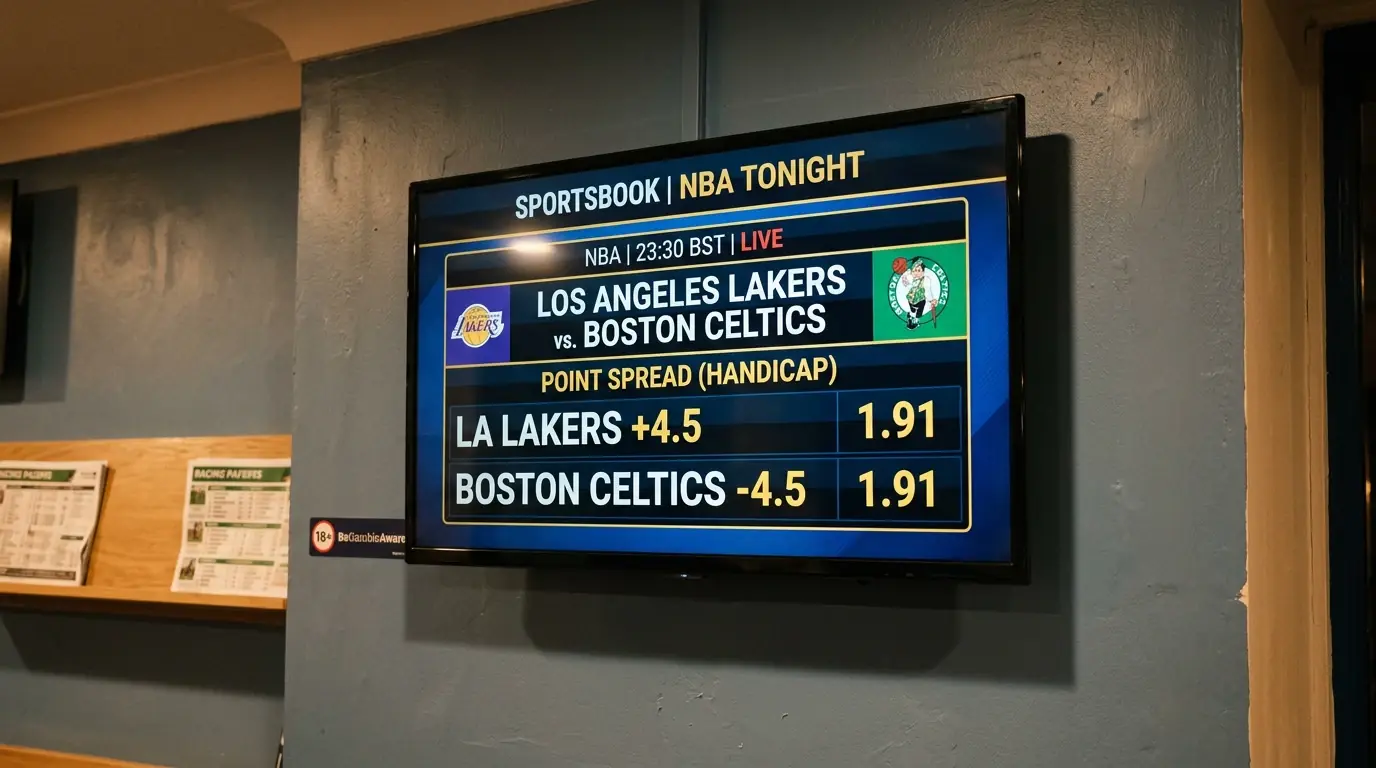
The live spread updates as the score gap evolves. If the pre-match spread was Boston −7.5 and Boston is up 14 in the second quarter, the live spread will sit somewhere around Boston −9.5 or −10.5 for the remainder of the game. The number reflects expected scoring across the time remaining — not the gap that already exists. This is the most common confusion I see in live betting: punters reading the live number as if it were the cumulative spread for the whole game.
The cleanest exploitable pattern on the live spread is the reversion bet. A team on a hot run gets punished by the model for the next few minutes — the live spread overcorrects in their favour. If you fade the team that just ripped a 14–4 run, you are betting against the model’s short-term momentum overweight. This works often enough across a long sample to be worth disciplined attention.
Live totals are similar but trickier. The total updates based on points scored so far plus expected points remaining. A first-quarter that finishes 32–28 for a combined 60 points will nudge the live total up. A first-quarter at 22–18 for 40 points will nudge it down. The trap is the same as the moneyline: the model corrects for randomness, but the casual punter often does not.
One quirk specific to live totals on NBA. Late in the fourth quarter, the live total can become almost unbettable. A game with seven seconds left and 218 points scored against a live total of 220.5 will not realistically produce 3 more points — the side losing the spread will hold the ball, the winning side will not foul, and the clock will expire with the under cashing. The live model knows this and prices the over at +800 or longer.
The discipline I impose on live spread and total bets: I do not bet the live number unless I have a specific read on what the model is missing. The model is fast, well-tuned, and updated constantly. Beating it in real time without an information edge is hard.
Quarter-by-Quarter In-Play Markets
Quarter-by-quarter in-play markets price each individual quarter as a self-contained game. Once the quarter ends, the market settles. Once the next quarter begins, a fresh market opens. This rolling structure is one of the more interesting parts of the live menu because each quarter is short enough to be priced from very different starting conditions.
Third-quarter markets are where I see the most meaningful in-play opportunity. Halftime adjustments matter in basketball — coaches change defensive schemes, lineup mix shifts, and the tempo of the third quarter often differs sharply from the first half. A team that came out flat in the first half and made halftime adjustments often opens the third with a better stretch than the model predicts; the live third-quarter spread tends to lag this for a few minutes after the second-half tip-off.
Fourth-quarter markets carry the opposite trap. Late in close games, the action gets sloppy in ways the model handles imperfectly — fouls, free throws, and intentional clock management distort scoring patterns. A live fourth-quarter total looks priced for normal-pace basketball but actually has to absorb the foul-and-free-throw stretch run. Sometimes that produces more points than the model expects; sometimes far fewer.
Quarter markets settle on the points scored within that quarter only — overtime is never included. If a game heads to OT tied at the buzzer of the fourth, the fourth-quarter market has already settled at the regulation score. Many punters assume the bet “rolls into” overtime. It does not. The market is sealed at the quarter’s end.
One specific UK consideration. Quarter markets carry slightly higher vig than full-game live markets — typically −115 on each side instead of −110. The reason is liquidity: quarter markets attract less volume, so the bookmaker prices in a thicker margin. Factor that into your edge calculation. A small live edge on a quarter line can disappear inside the extra juice.
Live Player Props and Next-Basket Markets
Live player props update through the game in the same way live moneylines do — as a player approaches their pre-match prop line, the live price stretches to reflect proximity to the threshold. A points prop set at 24.5 pre-match might price at −110 on the over before tip-off; mid-third-quarter with the player at 19 points already, the over is suddenly −250.
The live prop board reflects expected rate-of-scoring from this point forward. If a player scores 14 in the first quarter on a 24.5 line, the live over will collapse to −400 or lower because they only need 11 more points across three quarters. If the same player is held to 5 in the first quarter, the live over might stretch to +150 because the deficit to the line is large with limited time to make it up.
Next-basket markets are the fastest-resolving live bet on the menu. The market asks which team will score the next basket from the current possession. Both sides typically price between −115 and +115, depending on possession status and matchup. Because the bet resolves within seconds, next-basket markets are often used by live bettors to express short-term momentum reads — a team has just stolen the ball and is in transition, the next basket on that team prices accordingly.
The pricing problem with next-basket markets is the latency one again. By the time the price has updated to reflect the steal-and-fast-break, the play is often resolving on screen — and your bet is going in just as the shot is leaving the player’s hand. The book suspends the market when the play enters its decisive phase, which protects them from being beaten on a stale price. The window of usable next-basket pricing is usually 5–15 seconds at the start of a possession, less during fast play.
Live props are also where the post-2025 integrity reforms changed the menu most. After the federal charges filed against an NBA player and a head coach in October 2025 over alleged underperformance betting, several UK operators tightened their live prop offerings on lower-usage players, removed certain minutes-played markets entirely, and raised vig on the props that remained. The shape of the live prop board is genuinely thinner now than it was 18 months ago. The integrity environment is shaping the market in real time.
Cash Out: When the Book Pays You to Walk Away
Cash out is the live betting feature that has done more to change punter behaviour than any other product innovation of the last decade. The mechanic is simple: while a bet is still live, the bookmaker offers to settle it early at a calculated value reflecting the current probability of winning. You can accept the offer and walk away — or decline and let the bet ride.
The maths is transparent once you see it. If you bet £20 on Boston pre-match at 2.50 (potential return £50, profit £30) and Boston is up by 18 in the third quarter, the cash out value might be £42. That £42 is the bookmaker’s calculation of (current win probability × potential return) minus a margin. If Boston wins, you would have made £30 by holding; the cash out gives you £22 of profit now, sacrificing the remaining £8 in exchange for certainty.
The temptation is obvious. Locking in profit feels disciplined. But the maths tells a different story over a long sample. The cash out price always carries a margin — typically 4–8% — that the bookmaker keeps. Across many bets, a punter who routinely cashes out is paying that margin every time. Expected value of holding is higher than expected value of cashing out on most live positions.
The case for cashing out is not bad maths — it is bankroll discipline. If a £100 win would meaningfully change your weekend, or if a £50 loss would emotionally derail your next session, locking in the certain outcome can be the right call regardless of expected value. The Commission and the BGC both treat cash out as part of the wider responsible gambling toolkit, alongside the 1.5 million unique UK accounts that engaged with safer-gambling tools during Safer Gambling Week 2024 — a 22% rise on the prior year.
One nuance specific to UK NBA live betting. Cash out is not always available. Books suspend cash out during fast-developing plays — same suspension logic as bet placement — and can withdraw cash out entirely on certain markets if the live model cannot price it reliably. If you are planning to cash out at a specific point, plan for the possibility that the option is not available at the moment you want it.
The dedicated guide to NBA cash out for UK punters walks through the operator-by-operator implementation in more detail. The mechanic is consistent across UK books; the user experience varies, particularly around partial cash out, auto cash out, and the speed at which the offer updates during the game.
Partial Cash Out and Auto Cash Out
Partial cash out lets you cash out a portion of the original stake while leaving the rest live. If your original bet was £40 and the cash out value is £85, you might choose to cash out £40 of the position — banking £40 of profit immediately — and let £45 of the value continue running. If the bet wins, you pocket the remaining live portion at the original odds; if it loses, you have already secured the partial cash out.
The maths produces a hybrid risk profile. You convert some of the position to certainty and leave some of it exposed to the original outcome. Across a sample of bets, partial cash out earns less than full hold but more than full cash out — the bookmaker’s margin still applies to the cashed portion, but only to that portion.
Auto cash out is the automation layer on top. You set a target value at which the bookmaker should cash you out automatically — say, “cash out at £55 or higher” — and the platform monitors the live price and triggers the cash out when the threshold is hit. This solves the discipline problem of needing to be at your phone during the game; it also solves the fingers-too-slow problem of trying to react to a fast-moving live price.
The trap with auto cash out is the inverse problem of cash out itself: you can lock in a target that turns out to be far below where the price would have ended up. A £55 auto cash out triggered in the third quarter of a game your team eventually wins comfortably means you took the smaller pay-out when the larger one was sitting on the table. The discipline lives in setting the target deliberately rather than reactively — pick a number you are genuinely happy with regardless of how the rest of the game goes, and stick to it.
Reading Live Line Movement Without Tilt
Reading live line movement without tilt is the single hardest skill in in-play NBA betting. The numbers move every few seconds. Each move suggests a story. Each story tempts a bet. The discipline is to ignore most of them and act on a small handful — and the cost of failing that discipline is steady, slow bankroll erosion.
The first principle: most live line moves are just the model updating to the score. A team scores a basket, the live spread tightens by half a point. A team turns the ball over, the live moneyline drifts the other way. These are mechanical updates, not signals. Acting on them is the equivalent of placing a bet because the screen blinked.
The second principle: the moves worth attention are the ones that go further than the score alone justifies. If a team gives up a 12–0 run and the live spread has shifted by 6 points, that is the model overweighting the run. Genuine information would justify a 3–4 point shift; 6 is reactive. Reversion bets work in this gap.
The third principle: late-game line moves are usually noise. With four minutes to play and a six-point lead, the live moneyline can swing wildly on each possession because the model is correctly recalculating win probability with the time remaining. The swings are mathematically right; they just do not represent betting opportunities for casual punters.
The discipline check that has saved me real money: write down, before the game, the specific scenarios in which I will bet live. “If the favourite is down 8+ at halftime and the live moneyline is at +120 or longer, fade the run.” “If the total has moved 4+ points up off a hot first quarter, take the under at the new line.” Pre-committing to scenarios means I am betting a plan, not a reaction. Without the plan, the screen will eventually beat me.
Latency, Stream Delay and Fair-Play Rules
The single most underestimated factor in live NBA betting is the gap between what is happening on the court and what is happening on your screen. Both lag the actual game, and they lag it by different amounts.
Television broadcasts of NBA games carry a delay — typically 5–15 seconds for traditional cable feeds, 10–30 seconds for streaming services. The delay is partly built-in for technical reasons (encoding, distribution) and partly deliberate for compliance reasons.
The bookmaker’s data feed runs on a different track. Sports data providers feed the books official scoring and clock data via low-latency channels, often arriving 1–3 seconds after the actual on-court event. The book’s model processes the data and updates the live price within another 1–2 seconds. So the live price typically reflects the game state 2–8 seconds after the on-court event.
That gap matters because it varies. The book’s price might be 4 seconds behind reality; the broadcast you are watching might be 12 seconds behind reality. The book is always closer to live than your screen is. So a punter trying to bet on what they “see” in the broadcast is consistently chasing information the book has already priced in.
Fair-play rules at UK books address this directly. Most operators have explicit policies allowing them to void live bets placed during what they consider a “delayed” period — for example, a bet placed within 10 seconds of a clock-stopping event the book’s data showed as already resolving. The principle is that the book reserves the right to cancel bets where the punter appears to have been operating on information ahead of the book’s official update.
The practical takeaway: do not assume your screen is the truth. Treat the live price as the most current data you have access to. If you want to bet against the price, do it on the basis of model reasoning rather than visual reasoning. The visual is older than the price.
A Bankroll Plan for Live NBA Sessions
The single biggest difference between a profitable live NBA bettor and an unprofitable one, in my decade of watching this market, is bankroll discipline. Pre-match betting forces patience: you research, you wait for the line, you place the bet, you watch. Live betting strips that pacing out. Every minute is a temptation. Most live punters lose money not because they are bad at picking sides — they are losing because they are placing too many bets.
The framework I use for live sessions is bounded by three constraints. First, a total live bankroll for the session, agreed before the game starts and not raised during the session under any circumstance. Second, a maximum number of live bets — typically 3–5 per game, no exceptions. Third, a minimum 5-minute pause between bets, used for nothing other than re-reading the situation and asking whether the bet I am about to place is the bet I had pre-committed to placing.
The pre-commitment matters because live betting bypasses the parts of the brain that evaluate price. The flow of the game generates emotion, the screen generates urgency, and urgency generates worse decisions. Bets I would have rejected easily 30 seconds before tip-off get placed in the heat of a third-quarter run. Pre-committed scenarios are a reasonable defence — but only if the scenarios are written down before the game and not reinvented mid-stream.
The wider context is worth holding in mind. Andrew Rhodes has noted that participation in gambling has remained stable at 48 percent of British adults — almost half the adult population — and the data the Commission publishes on safer-gambling tool use suggests an increasing share of those punters are using deposit limits, time-out tools, and reality checks to structure their sessions. The architecture exists. Whether you use it during a live session is the question that decides whether the architecture works for you.
One specific habit I keep. After every live NBA session, win or lose, I log how many bets I placed and how the count compared to my session limit. The data tells me, over a sample, whether my discipline is holding. If I am routinely bumping up against the upper end of my bet count limit, the limit is too high. The numbers are honest in a way that the in-game experience is not.
Live NBA Betting: Quick Answers
Three questions about live NBA betting come up often enough to deserve their own section.
Why does a UK book suspend an NBA market mid-possession?
The book suspends the market — meaning bets cannot be placed or cancelled — during fast-developing plays to protect against latency-based exploitation. The book’s data feed lags the on-court event by 1–3 seconds, and the model takes another 1–2 seconds to update the price. During that window, a punter with a faster information source could in principle bet against a stale price. Suspension closes that window. Suspensions usually last 1–5 seconds and resolve once the play has fully settled.
How is cash out value calculated during an NBA game?
The cash out value is roughly the current win probability multiplied by the potential return, minus a margin the bookmaker keeps for itself. So a £20 bet at 2.50 odds (potential return £50) with the team currently 80% likely to win might offer cash out of around £36–£38, depending on the operator’s margin. The price updates in real time as the game progresses. The margin is typically 4–8% of the underlying value.
Is the live stream on a UK sportsbook delayed compared to TV?
Yes, all live streaming carries delay relative to the actual event, and most streams are delayed by 10–30 seconds depending on the protocol. Traditional TV broadcasts run 5–15 seconds behind. The bookmaker’s data feed is closer to live than either — typically 2–8 seconds behind the on-court event. The implication: do not bet on what you see in the stream as if it is current information. The live price has already incorporated more recent data than the stream is showing.
Created by the ”how Does nba Betting Work” editorial team.