Age Verification and KYC for UK NBA Bettors
 Available in US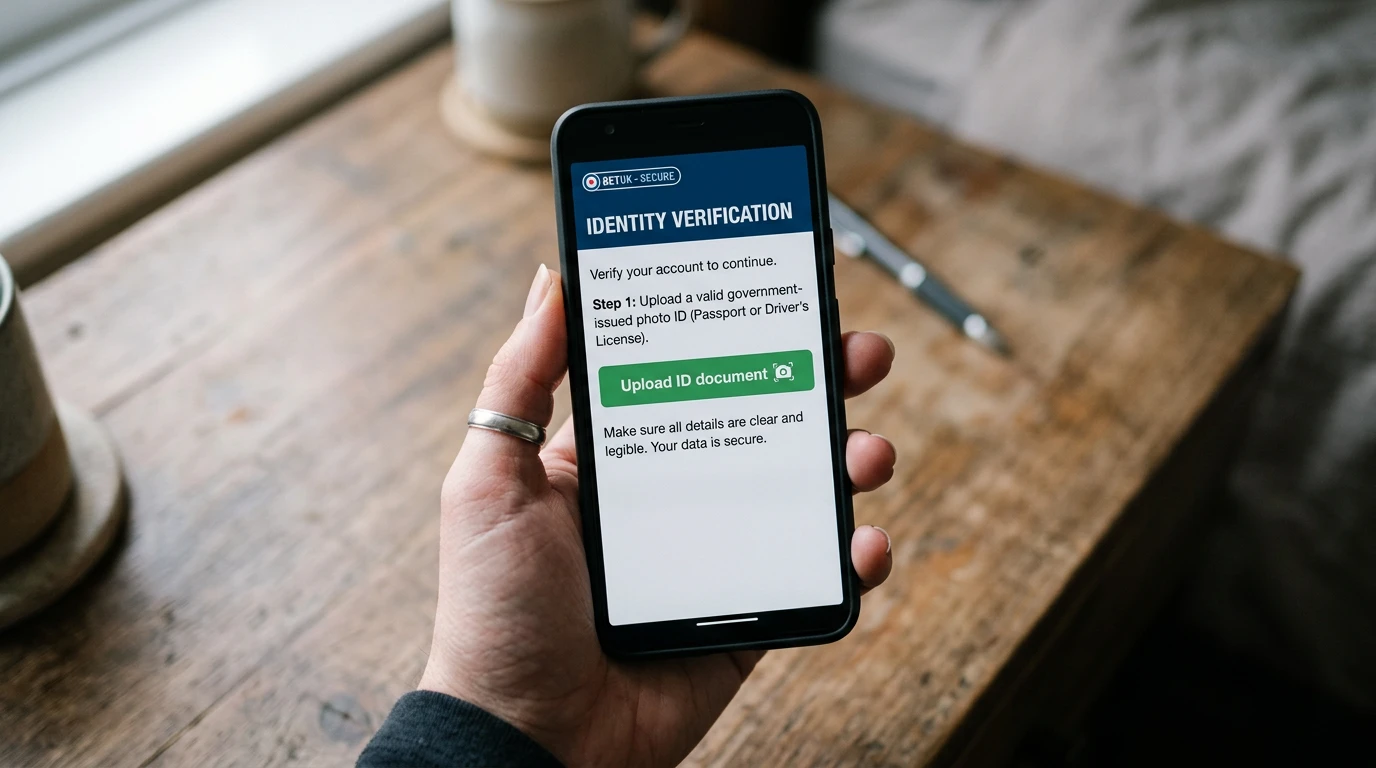
Before You Place Your First NBA Bet
The customer-onboarding sequence at a UK NBA book takes between four and twenty minutes depending on how cleanly your data flows through the verification pipes. The fast end of that range looks frictionless – name, address, date of birth, an automated CRA query, a soft document check, and you’re live. The slow end looks like a passport upload, a selfie comparison, a bank-statement request, and a manual review queue. Same regulatory framework. Different customer experiences depending on how your data behaves.
Every UK-licensed operator must verify customer age before allowing any betting activity. That’s the headline rule, codified in the Commission’s licence conditions and policed actively. Tim Miller of the UK Gambling Commission has framed the underlying rationale clearly – speaking on the recent prevalence research, he noted that the move from 1.5% to 1.2% youth problem-gambling rates is statistically stable and meaningful, and the verification architecture is part of why that direction holds. The 18+ rule isn’t a bureaucratic afterthought. It’s a load-bearing pillar of the welfare framework.
The 13.5 million active UK gambling accounts running through the system pass through this onboarding architecture, and the design constraints are real. Verify too loosely and minors slip through; verify too tightly and recreational punters drop out at registration. The UK framework has settled on a relatively heavy-touch approach by international standards, with mandatory documentation pathways and ongoing re-verification triggers. For the NBA punter opening their first account, knowing what’s coming makes the journey feel routine rather than invasive.
I’ll walk through the actual sequence: the 18+ rule and why it’s policed strictly, the KYC documents and what triggers escalation, the source-of-funds layer that sits behind the basic check, and the additional protections that apply specifically to 18-24 NBA bettors.
The 18+ Rule and Why It’s Strict
The minimum age for any UK gambling activity is 18, full stop. There are no carve-outs for sports betting versus casino, no exceptions for low-stakes “fun” bets, and no operator latitude to bend the rule for a 17-year-old who’s “almost 18.” The hard line is the line, and it’s enforced at the registration step, at the deposit step, at the bet-placement step, and at the withdrawal step.
The reasoning behind the strict policing isn’t just abstract welfare theory. The 1.2% youth problem-gambling rate among 11-17 year olds, while down from earlier years, represents a population in active development whose risk profile diverges sharply from adult bettors. Adolescent neurology around impulse control and reward sensitivity makes early gambling exposure substantially more damaging than equivalent exposure at 25. The architecture protects against that reality.
Operators face severe enforcement consequences for under-18 access. Licence suspensions. Multimillion-pound fines. Public regulatory action that damages brand value far beyond the immediate financial penalty. The Commission’s 9,700 compliance actions across the most recent reporting window included multiple cases of under-18 access failures, and the enforcement signal has tightened operator behaviour significantly over the last five years.
The verification at registration uses three layers. First, the customer self-declares date of birth. Second, the operator queries credit reference agency data for an identity match including DOB. Third, where the CRA query returns ambiguity or insufficient data, the operator requests a passport, driving licence or government-issued ID for manual review. The third layer catches the cases where automated verification can’t resolve identity confidently, and it’s where many young customers see friction at signup.
Pre-account-funding access – browsing the site, looking at NBA odds, reading the markets – typically doesn’t require age verification. Once any deposit attempt or bet placement happens, full age verification must be complete. Some operators apply softer pre-deposit verification just to enrich their data file. The heavyweight check sits at the deposit-or-bet boundary.
KYC Documents and Timing
“Know Your Customer” – KYC – is the broader identity verification framework that sits over and around the age check. KYC verifies who you are, where you live, that the funding instrument you’re using is yours, and that you’re not on any sanctions or politically-exposed-persons list that would require enhanced due diligence.
The documents requested at a UK NBA book typically include a photo ID, a proof of address, and confirmation of payment method ownership. The photo ID can be a passport, UK driving licence, or national identity card from another EU member state. The proof of address is usually a recent utility bill, bank statement, or government correspondence dated within the last three months. Payment method confirmation might be a bank-card photo or a screenshot of the bank app showing the card details.
Timing varies by operator and by the cleanness of the underlying data. For customers with strong credit-reference profiles – long-established UK address, mainstream UK bank, valid UK driving licence – the entire verification can complete automatically through API queries to the CRAs without any document uploads. Frictionless verification of this type happens for the majority of UK-resident customers.
For customers whose data doesn’t pass the automated tier – recent address changes, thin credit files, non-UK ID documents, or a name-spelling mismatch between bank records and government records – the manual review queue applies. Documents get uploaded, an operator reviewer verifies them against template fraud-detection rules, and the verification completes within typical SLAs of 24 to 72 hours. During the review window, the account exists but functionality is restricted: deposits may be blocked, bets may be limited, withdrawals are usually held until verification clears.
The full landscape of how UK NBA betting regulation operates in 2026 sits behind these verification flows. The UK Gambling Commission audits operator KYC completion rates as part of licence supervision, and operators that show patterns of incomplete or sloppy KYC face escalation. The architecture has evolved towards requiring verification to be complete before any meaningful customer activity, which is more conservative than some international jurisdictions but reflects the UK regulatory culture.
One detail UK punters miss: the verification at one operator doesn’t carry over to another. Each UK NBA book runs its own KYC process, and opening a second account at a different operator means a fresh verification cycle. The Single Customer View architecture being phased in through 2026 may eventually consolidate this, but for now, KYC is per-operator.
Source-of-Funds Requests
The source-of-funds layer sits above standard KYC. Where KYC verifies who you are, source-of-funds verifies how you came to have the money you’re depositing. The trigger thresholds vary, but the BGC voluntary code’s £25,000 net-deposit-over-12-months threshold is the working benchmark in the UK industry.
Above the SoF threshold, operators are required to satisfy themselves that the deposited funds come from legitimate sources – salary income, business income, declared investment returns, or other lawful provenance. The process typically involves a request for bank statements covering a few months, payslips or tax records, and sometimes a written explanation of fund origin. The operator reviews the documents against the customer’s claimed circumstances and either accepts the SoF as adequate or escalates to enhanced due diligence.
For the recreational NBA bettor, source-of-funds is a non-event. The £25,000 threshold isn’t crossed by anyone betting £20 a night across a season – even a heavy regular punter staking £200 a week is at £10,400 across a year, well under the threshold. The SoF layer applies to high-stakes customers and to cases where the deposit pattern doesn’t match the demographic profile in ways that flag automated risk-scoring.
What does flag automated risk-scoring is unusual deposit velocity. A new customer who deposits £8,000 in their first week pulls SoF attention even though the BGC threshold is £25,000 over a year – the velocity rather than the absolute amount drives the review. Same applies to sudden escalation. A customer who deposited £100/month for two years and suddenly deposits £2,500 in a single week sees a soft SoF nudge, often a one-screen confirmation of fund origin without full documentation.
The customer experience during an SoF review can feel intrusive. UK operators are required by law to ask these questions when triggers fire, but the regulatory architecture also requires them to handle the data with strict information-security protocols. SoF documents you provide aren’t accessible to the rest of the operator’s commercial functions – they sit in a compliance-only data path. The privacy framework is robust by international standards, even if the document-request moment feels uncomfortable.
Extra Layers for 18-24 Bettors
The 18-24 cohort lives under tighter rules than the over-25 customer base, and the differences are deliberate. Lower default deposit limits at registration. Faster trigger to financial vulnerability checks. The £2,500 BGC voluntary threshold for 18-24 customers replaces the £5,000 over-25 threshold for enhanced due diligence. More conservative bonus and free-bet promotional offers. Tighter advertising rules around content visible to the cohort.
Tim Miller has framed the rationale around the prevalence data – the move from 1.5% to 1.2% problem gambling among 11-17 year olds is statistically stable and reflects sustained welfare gain, and the architecture protecting young adults aims to extend that gain across the age 18-24 transition where vulnerability traditionally remains elevated. The 49% of 11-17 year olds reporting weekly exposure to gambling advertising on social media adds context to why the operator-side protections sit higher at the bottom adult age band.
For NBA bettors specifically aged 18-24, the practical layers stack as follows. At registration, deposit limit defaults will be lower – often £100 monthly versus £250 monthly for older customers. The first FVC trigger may apply at lower thresholds, sometimes £100 net deposits over 30 days versus the standard £150. Promotional offers will be more conservative, with smaller welcome bonuses, lower-stakes free bets, and fewer reactivation offers. Communications cadence will be lower, with operators required to limit marketing frequency to the young-adult cohort.
The trade-off is that 18-24 punters who want to bet at higher tiers face more friction proving they can do so responsibly. Source-of-funds checks land sooner. Enhanced due diligence triggers sooner. Re-verification cycles run more frequently. None of this prevents responsible young-adult betting – it slows it down and adds checkpoints that catch the cases where slippage is happening early rather than after several years of escalation.
For 18-24 NBA fans coming into the UK book market for the first time, the architecture is more visible than it would be at 35. That’s by design. The verification, documentation and limit-setting touches that an older customer might not notice are foregrounded, which can feel patronising and is in fact welfare-driven. The 1.2% youth problem-gambling figure is the empirical anchor for the whole architecture, and the 18-24 protections are the bridge between the adolescent-protection framework and the standard adult framework.
Why the Onboarding Looks the Way It Does
The UK NBA betting onboarding flow looks the way it does because of accumulated regulatory learning across two decades of evolving practice. Earlier frameworks were lighter, with less age verification, less KYC, and less affordability architecture. The outcomes weren’t good – under-18 access slipped through, problem-gambling cases escalated faster than the support infrastructure could handle, and high-profile failures eroded public trust in the industry’s licence to operate.
The current architecture trades onboarding friction for systemic integrity. Customers who want to bet on tonight’s NBA game complete a fifteen-minute setup once and then have years of relatively frictionless activity within the licensed framework. The regulatory checks at the boundary – registration, threshold deposits, periodic re-verification – are concentrated at the moments where the data tells us welfare attention matters most. The middle of the customer journey is meant to feel like normal commerce.
For the new UK NBA bettor, the practical advice is simple. Be ready with your ID and proof of address before you start the registration. Use the bank account or card that’s actually yours. Set a deposit limit that fits your real budget rather than your aspirational budget. Don’t try to circumvent verification – the friction it creates is far less than the alternative outcome of an indefinitely-restricted or closed account. The first fifteen minutes are an investment in years of routine activity within a regulated environment that does meaningful work to protect the customer base.
How long does NBA bookmaker KYC usually take?
For UK customers with strong credit-reference profiles, automated KYC completes in seconds during the registration flow with no document uploads required. For customers whose data doesn’t pass the automated tier, document review typically resolves within 24 to 72 hours. Manual review queues vary by operator load, but the SLA bands are consistent across the regulated UK market.
Will winnings be held until KYC is complete?
Yes, in most cases. UK operators are required to confirm customer identity before processing significant withdrawals, and a typical industry standard is that any withdrawal above a few hundred pounds requires verified KYC. Smaller withdrawals may process without full verification at some operators, but the safer assumption is that complete KYC is needed before withdrawing any winnings.
Created by the ”how Does nba Betting Work” editorial team.