NBA Cash Out: How Books Pay You to Walk Away Mid-Game
 Available in US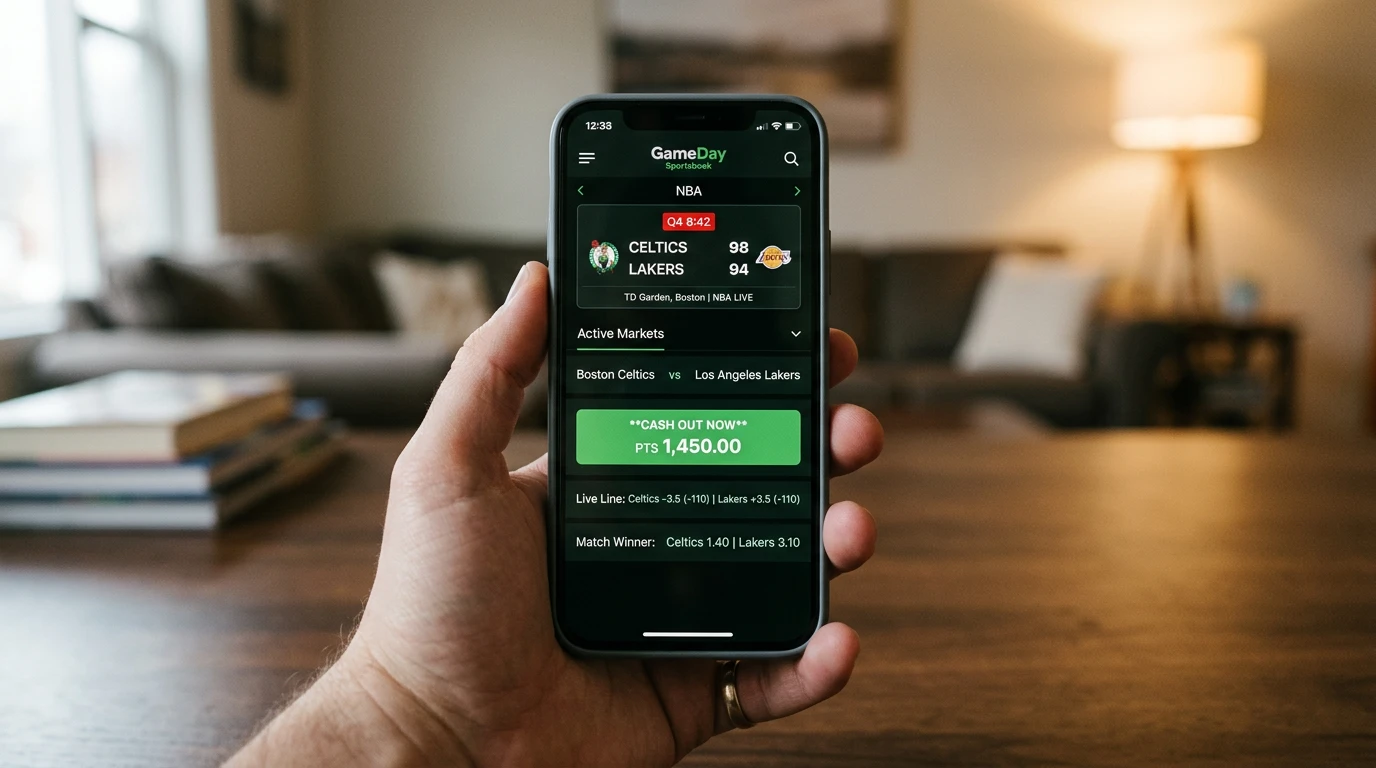
What a Cash-Out Number Really Means
I had a four-leg parlay running halfway through a Tuesday night triple-header. Three legs in the bag, one to go – Lakers minus the spread late in the third. The cash-out button popped up at £43 against my £10 stake. The full payout if it landed sat at £71. The Lakers were up nine. I clicked through, took the £43, and watched them lose by two on a buzzer-beater. The point isn’t that I made the right call – variance went the way it went. The point is that the £43 wasn’t generosity. It was the operator’s number, calculated from their model, with their margin baked in, on offer for that one moment.
Cash out is the most-used live feature on UK NBA accounts and the least-understood one. The button looks like a friendly gesture – “would you like to take some money now?” – but the value behind it is a cold equity calculation. The operator computes the live probability of your bet winning, multiplies that by the potential payout, applies a margin haircut, and offers you the resulting figure. Sometimes the haircut is small. Sometimes it’s brutal. The customer-facing experience hides the maths under a single tap.
Real-event in-play GGY rose 16% year-on-year across the most recent quarter, which tells you live volume is climbing fast in the UK market, and cash out is one of the dominant friction points where that volume meets customer decisions. The 1.5 million UK accounts now actively engaging with safer-gambling tools include a meaningful slice of customers using cash out as part of self-management – the button isn’t only an upsell device, even if its primary commercial function is to let operators bank a margin from the live state of your existing bet.
I’ll work through what actually happens behind the button: the live valuation maths, the partial cash-out variant, the auto-trigger configuration, and the moments where the offer is genuinely generous against the moments where you’re being charged a tax for the convenience.
How Live Valuation Is Calculated
Strip away the marketing and the cash-out value at any moment is a straightforward equation. Take the live probability of your bet winning, multiply by the original payout, and subtract the operator’s margin. The output is the number on your screen.
The live probability comes from the operator’s pricing model – the same engine that prices the live spread, total and moneyline markets you can bet against currently. If the bet you placed is “Celtics -3.5 pre-game,” and the live spread is now Celtics -7 with the game at 80-72 in the third quarter, the model has a probability for the original -3.5 line resolving in your favour. That probability gets pushed through the cash-out engine.
The operator’s margin in the cash-out value is typically 5% to 10% beyond what the underlying probability would imply. That’s the cost of convenience – the operator is offering you a guaranteed payout in exchange for taking the residual variance off your hands, and they’re pricing that service. Some books are tighter, some are looser, and the same book can be tighter on some markets than others.
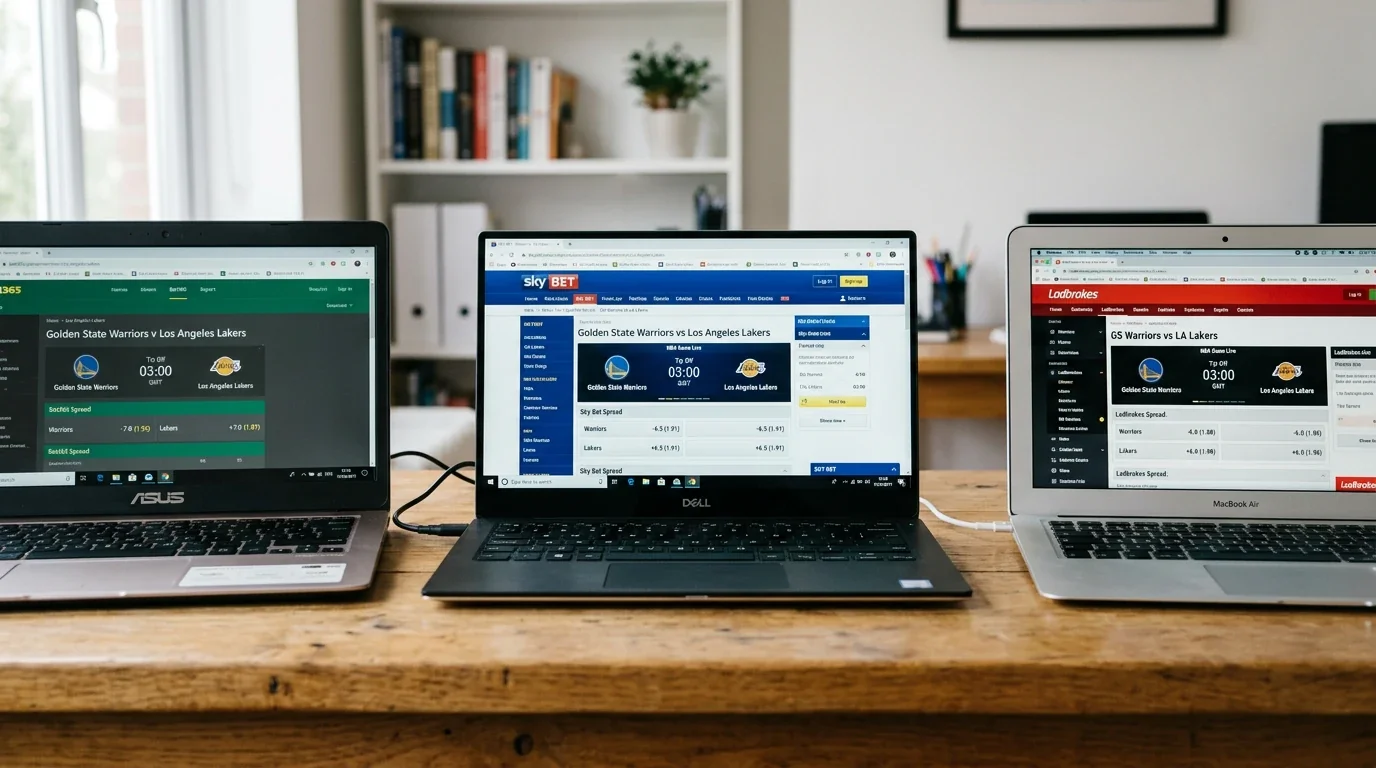
The way to see whether your cash-out offer is fair is to check the live odds against the same outcome at the same operator. If the live moneyline on Celtics has them at -300 and your pre-game cash-out value implies a probability significantly below 75%, the operator is taking more than the standard margin out of your number. If the implied probability matches the live odds within the standard margin band, the offer is at the operator’s normal pricing tier.
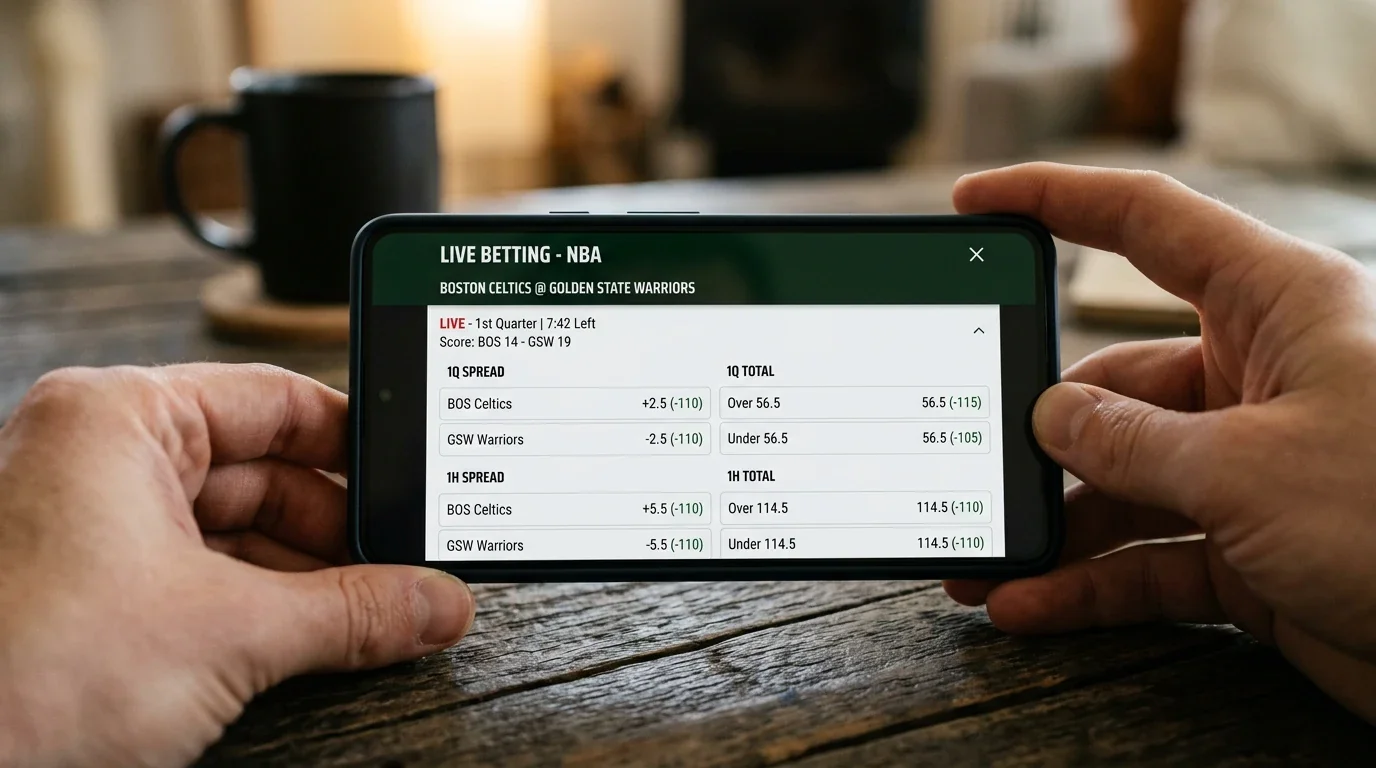
Suspended cash-out is a separate beast. When the game state changes rapidly – a buzzer attempt, a foul on a three-point shot, a timeout decision – the operator’s model can’t price reliably for a few seconds. The cash-out button greys out during the suspension. The bet itself is unaffected, but you can’t take the offer while the suspension runs. Suspended states typically last between five seconds and forty-five seconds depending on the event.
Latency matters too. The cash-out value displayed on your screen reflects the operator’s view of the game state at the moment of last refresh – usually a few seconds behind the actual live game. If you’re watching on a faster stream than the operator’s data feed, you can sometimes see events develop before they’re priced in, but the moment you tap, the operator validates against their current state and may reject the cash-out at the displayed value if the game has moved significantly. Build the lag into your decision-making.
Partial Cash Out
Partial cash out lets you take a fraction of the available cash-out value while leaving the rest of your stake live in the bet. The mechanic is simple – you choose what percentage of the original bet to cash out, the operator pays you the corresponding fraction of the live value, and the remainder of your bet continues at the original odds.
The use case is clear. You backed a £20 NBA spread bet pre-game. Mid-third, the cash-out value sits at £35. You want some certainty but you’re not ready to walk away entirely. You partial-cash 50%, taking £17.50, and £10 of original stake stays live. If the bet ultimately wins, you collect the remaining payout. If it loses, the £17.50 you already pocketed insulates the worst case.
The economics of partial cash out are mostly a wash. The operator applies the same margin haircut to the partial value as to a full cash-out, scaled proportionally. There’s no arbitrage where partial cash-out beats full cash-out from a pure expected-value perspective. What partial cash-out buys is the psychological comfort of staged risk reduction – you’re spreading the decision across two moments rather than betting everything on one tap.
For NBA bettors specifically, partial cash-out fits cleanly with the natural rhythm of the game. The end of the third quarter is a common partial-cash moment for spread or moneyline bets that have been running well. The two-minute warning in the fourth is another. The all-or-nothing decision at those moments is heavier than a partial – and the cumulative result of a season’s worth of partial cash-outs typically tracks closely to either holding-to-end or full-cashing each time, with the partial route producing a smoother variance curve.
Some UK operators support partial percentages with arbitrary granularity (any value between 1% and 99%). Others restrict partial cash-out to fixed tranches (25%, 50%, 75%). The granularity matters less than the existence of the feature itself – even fixed tranches give you the staged-decision option that pure cash-or-hold doesn’t.
Auto Cash Out and Triggers
Auto cash out is the set-and-forget version. You configure a trigger condition – typically “cash out automatically if the value reaches £X” – and the operator fires the cash-out instruction the moment the threshold hits. The bet exits the system at the auto-trigger value and you don’t need to be watching the screen to take the gain.
The use case writes itself. You’re at work during a UK afternoon NBA game tipping off in the morning Pacific window. You backed a moneyline pre-game. Setting an auto cash-out at, say, 70% of the full payout means that if the bet trends well during the game and reaches that value, you bank the gain automatically rather than discovering at end-of-game that you blew through a peak value down to a loss.
The configuration nuances vary. Some operators support a single auto-trigger value. Others support stair-stepped triggers – partial cash-outs at multiple thresholds, with the remainder running. A few support trailing triggers, where the auto-cash level rises with the bet’s live value but locks once a peak is hit. Trailing auto-cash is the most sophisticated tooling in the UK market, and it’s available at a small subset of operators.
The danger zone for auto cash out is when the trigger value is set just above the live value at bet placement. A bet placed pre-game at +200 with a £20 stake has a £60 potential payout. If you set auto-cash at £25, the bet is one favourable moment away from triggering, and the live value can hit that threshold during a single fortunate transition basket in the first quarter. Auto-cash is then locked at £25 of profit on a £20 bet that might have settled at £60. The trigger achieved its mechanical objective and cost you the upside.
Set auto-cash thresholds based on a clear-headed view of acceptable outcomes, not based on tilt-management impulses. The trigger you set on a Sunday morning doesn’t have to defend you from a panic-tap on a Tuesday afternoon – but it can if you set it at a number you wouldn’t be tempted to hold past in calm circumstances.
When Cash Out Helps and When It Hurts
Cash out is genuinely useful in three scenarios and a tax in most others. Knowing the difference is the entire skill of using the feature without leaking value.
Scenario one: hedging a positive outcome you can’t comfortably let ride. You backed a long-shot futures bet earlier in the season – a team to make the conference finals at +800 stake £20 – and they’re now in the conference finals up 3-1 in the series. The cash-out value might be £140. The full payout if they win the series is £180. Tapping at £140 locks in 78% of the maximum return with zero residual variance. For most punters, that’s a clean trade against the £40 of remaining upside that depends on closing out a series under playoff pressure.
Scenario two: protecting a stable lead in a single game where the line has moved in your favour. You backed a -3.5 spread pre-game and the team is up nine with three minutes left. The cash-out value will be close to the full payout. Tapping at that point removes the small but non-trivial probability of a furious comeback. The operator’s margin haircut is mild because the residual probability is mild. Take it.
Scenario three: cutting losses on a bet that’s gone wrong but isn’t fully resolved. You backed an over and the game is significantly slower than expected – both teams shooting poorly, lots of fouls, deliberate possessions. The cash-out value will be a fraction of your stake, but it’s better than zero. Taking 30p on a £10 over that’s almost certainly going to settle as a loss is a small recovery – about 3% of stake – and over a season those small recoveries add up.
The scenarios where cash out hurts are everything else. Mid-game with the bet roughly where the model expects it to be, the cash-out value reflects pure margin extraction. Tap and you lose the operator’s haircut for nothing. Late-game when your bet is favourite but the value reflects the favourite’s price minus margin – you’re paying the operator to bank a result you’d statistically have collected anyway.
Reading NBA live line movement without tilt is the broader skill that makes cash-out judgement work. If you can read whether the live spread move is meaningful or noise, you can read whether the cash-out value is fair or expensive. The two skills travel together, and either alone is incomplete.
The Right Way to Use the Button
Cash out is a tool, and like any tool it gets used best when the user has a clear mental model of what it does. The cash-out value is the operator’s price for taking your residual variance – sometimes a fair price, sometimes a high one. The customer who understands that frame uses the feature selectively. The customer who treats cash out as a generous gesture leaks margin on every tap.
For UK NBA punters specifically, my practical guidance is simple. Use cash out for hedging serious positions in playoffs and futures markets where the variance reduction has real psychological value. Use partial cash out as a staged-risk tool for bets you’ve been carrying for a while. Skip cash out on routine single-game bets where the haircut isn’t worth the convenience. Configure auto cash-out only where you’ve thought clearly about the threshold rather than setting it reflexively.
Why does cash out get suspended at the free-throw line?
Free throws are a sequence of high-leverage events that change win probability rapidly between attempts. The operator’s pricing model can’t update reliably in the gaps between free-throw attempts, and the cash-out button greys out during the sequence. Service typically resumes within fifteen seconds of the final free throw being taken, once the live state has resolved.
Is cash out always at a worse number than the live odds?
Yes, structurally. The cash-out value includes the operator’s margin haircut beyond what the live odds would imply on a clean probability basis. If you compared the cash-out number directly against the implied probability from current live odds at the same operator, you’d see a 5-10% gap representing the cash-out tax. The convenience of guaranteed payout is the value you’re paying for.
Written by the editors at how Does nba Betting Work.